For flight test engineers, program managers, and defense procurement professionals, understanding where the market stands in 2026 matters. It shapes vendor selection, program planning, and technology investment decisions.
This article covers the current market size, long-term growth trajectory through 2031, the key technical and programmatic drivers, how the US market compares globally, and what it all means for organizations operating in the flight test and defense telemetry space.
Key Takeaways
- The global aerospace and defense telemetry market is valued at ~USD 2.23 billion in 2026, projected to reach USD 3.12 billion by 2031
- Market growth is forecast at a ~7% CAGR through 2031, based on aggregated estimates across major research reports
- North America holds the largest regional share (~35.7%), with Asia-Pacific growing fastest at 8.88% CAGR
- Key demand drivers include hypersonics programs, UAV proliferation, satellite constellations, and ISR modernization
- US defense R&D and test investment, backed by active federal test range infrastructure, anchors domestic market leadership
What Is Aerospace and Defense Telemetry?
Aerospace and defense telemetry is the automated, real-time measurement and wireless transmission of data—speed, temperature, pressure, structural stress, GPS position—from airborne or space-based platforms to remote ground stations for monitoring and analysis.
Telemetry underpins missile testing, hypersonic vehicle evaluation, ISR platform operations, UAV mission monitoring, spacecraft health tracking, and flight test certification programs. Without it, safety-critical decisions cannot be made in real time.
The Full System Chain
Understanding the market's breadth requires seeing the complete signal chain:
- Onboard sensors — measure parameters across the test article
- Airborne transmitters — encode and broadcast data over RF links
- Ground receiving antennas — capture the RF signal
- Receivers and demodulators — process the incoming signal
- Bit synchronizers and decommutators — extract and decode the data stream
- Data display and archiving platforms — present and store results for analysis
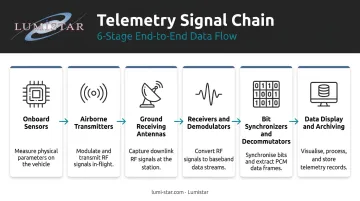
Each element in this chain represents a distinct product category contributing to the market's total value. All components must comply with IRIG 106 to operate reliably across the US federal test range network.
Aerospace and Defense Telemetry Market Size and Growth Projections
2026 Baseline and the Path to 2031
Three independent research sources all point to the same trajectory:
| Source | 2022/2025 Baseline | 2026 Estimate | End-Point Forecast | CAGR |
|---|---|---|---|---|
| Mordor Intelligence | USD 2.08B (2025) | USD 2.23B | USD 3.12B by 2031 | 6.99% |
| Global Market Insights | >USD 1.5B (2022) | — | USD 3.0B by 2032 | 7.0% |
| MarketsandMarkets | USD 1.4B (2022) | — | USD 2.0B by 2027 | 6.9% |
The CAGR consensus is unusually tight—6.9% to 7.0% across all three sources. When three firms using different datasets and models land within 0.1 percentage points of each other, the directional case for sustained growth is difficult to argue against. At Mordor's 2026-to-2031 trajectory, the market adds roughly USD 890 million over five years—a sustained expansion, not a spike.
Regional Breakdown
North America holds the largest revenue share at 35.7% in 2025 per Mordor Intelligence, underpinned by the world's largest defense budget, a dense network of federal test ranges, and a mature aerospace industrial base.
Asia-Pacific is the fastest-growing region at 8.88% CAGR through 2031—outpacing the global average by nearly two full percentage points. China's satellite production, India's launch programs, and Japan's miniaturized electronics manufacturing are all cited as contributing factors. MarketsandMarkets identifies India as the fastest-growing individual country market within APAC.
Hardware Refresh as a Demand Driver
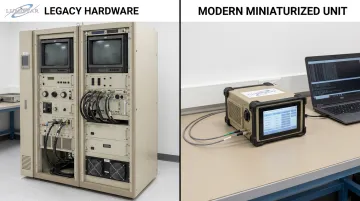
Beyond new program starts, an installed-base replacement cycle is running in parallel. Rack-mounted, power-hungry systems from the 1990s and early 2000s are being replaced by software-defined, miniaturized architectures—creating procurement activity that doesn't depend on new platform development.
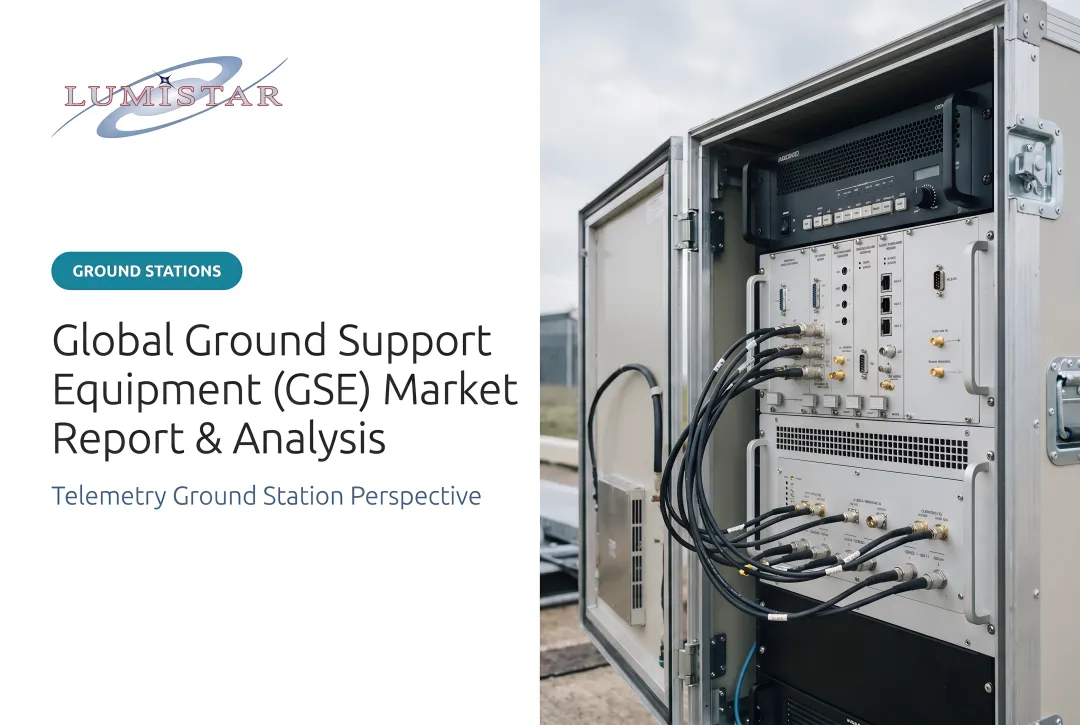
The scale of that hardware shift is significant. Lumistar's own product evolution traces the arc: ground stations that once stood 8 feet tall and weighed 250 kg now fit in a hand-held unit under 1 kg and 50 watts. For procurement officers budgeting refresh cycles, that reduction in size, weight, and power (SWaP) translates directly into reduced logistics, support, and lifecycle costs.
Key Drivers Fueling Market Growth Through 2031
Hypersonic Program Expansion
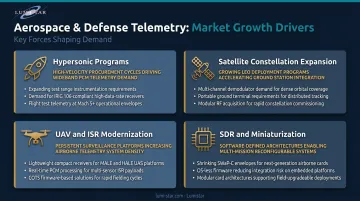
Hypersonic vehicles traveling at Mach 5+ create plasma sheaths around the airframe during flight—and AIAA research confirms that shock heating in these regimes causes telemetry signal attenuation and outright blackout. Solving this demands purpose-built, high-bandwidth, heat-resistant telemetry hardware that conventional flight test systems cannot provide.
The procurement scale is significant. The DoD's FY2026 budget requested USD 3.9 billion for offensive hypersonic research, with the Congressional Research Service identifying six active US offensive hypersonic programs under Army, Air Force, and Navy development. Russia has fielded Avangard, Tsirkon, and Kinzhal; China has fielded the DF-17 and DF-ZF HGVs. The strategic logic driving US hypersonic testing—and the telemetry infrastructure to support it—isn't going away.
DoD also identified 48 critical hypersonic test facilities and mobile assets, including 11 open-air ranges and mobile instrumentation such as the Transportable Telemetry System. Each of those facilities represents active or planned telemetry infrastructure investment.
Satellite Constellation Proliferation
Every satellite added to a LEO constellation requires onboard health monitoring, orbital tracking, and payload data transmission—all telemetry functions. The FCC has partially authorized 7,500 Gen2 Starlink satellites for SpaceX, and Amazon's Project Kuiper has its own FCC authorization in place. As constellations grow, so does demand for ground receiving infrastructure and spacecraft telemetry hardware.
UAV Proliferation and ISR Modernization
Unmanned aerial systems now span combat, reconnaissance, and test missions. Each new UAS program requires a full telemetry chain—and the volume of active programs globally drives sustained hardware demand across all segments.
ISR platform upgrades compound the effect. As military organizations replace aging airborne intelligence platforms, each new radar, electro-optical, or electronic intelligence payload requires:
- Higher-bandwidth data links to transmit larger sensor outputs
- Updated ground station receivers compatible with modern waveforms
- Expanded decommutation and processing software to handle new data formats
Software-Defined Radios and Miniaturization
SDR technology enables frequency-agile, reconfigurable transmitters that serve multiple mission profiles on a single hardware platform, eliminating the need for separate hardware per frequency band or modulation standard. Combined with the push toward smaller SWaP (size, weight, and power) profiles, SDR and miniaturization together are shortening refresh cycles across both airborne systems and ground stations.
Market Segmentation: Components, Platforms, and Communications
Component Segments
- Transmitters and sensors — dominant revenue segment; present in every telemetry chain
- Ground receiving equipment — high-growth sub-segment as programs replace aging infrastructure
- Software and data analytics platforms — fastest-growing category as organizations move toward software-defined ground stations and real-time decommutation over Ethernet
Platform Segments
Based on Mordor Intelligence's 2026 segmentation:
- Fixed-wing aircraft — largest current platform share
- Spacecraft and launch vehicles — growing rapidly due to commercial space activity
- UAVs — fastest-growing platform category
- Missiles and projectiles — significant but specialized niche
Communications Technologies
RF remains dominant. The core bands in use across flight test telemetry are:
- S-band (2200–2400 MHz) — standard for most aeronautical test programs
- L-band (1435–1540 MHz and 1710–1850 MHz) — widely used for airborne and range applications
- C-band (C1/C2) — common in specialized test range configurations
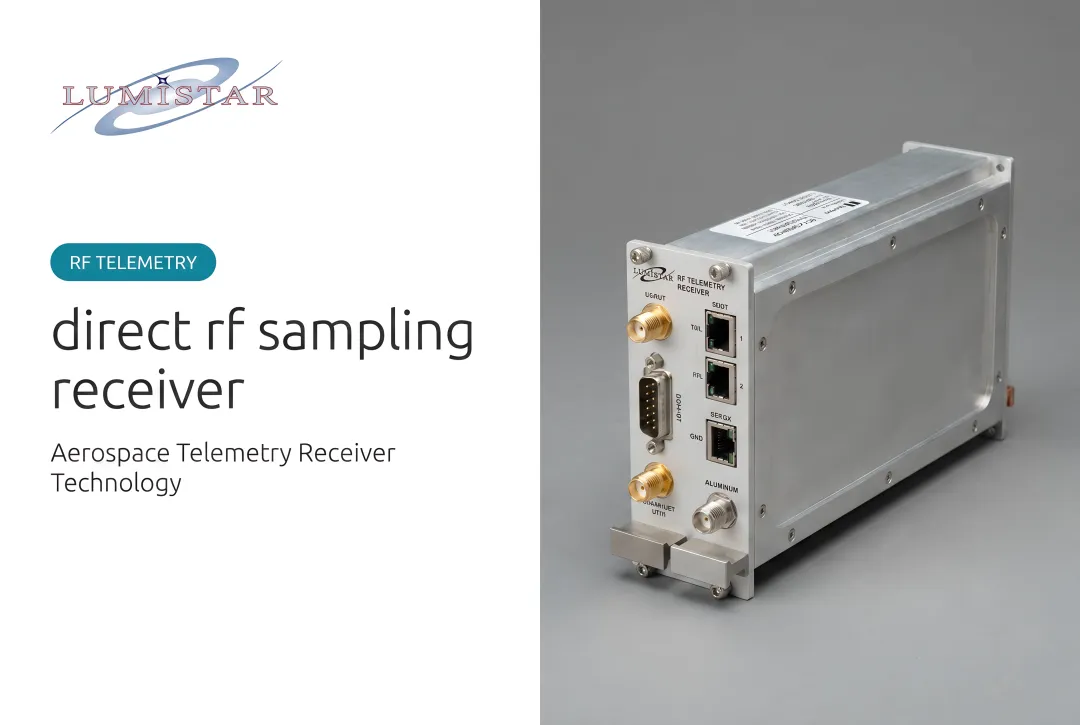
All three are standardized under IRIG 106. Lumistar's LS-28-DRSM covers all three bands plus custom frequencies from 200 MHz to 6 GHz. It is compliant with IRIG 106 Chapter 4 Class I and II requirements.
Beyond RF, two additional technologies are gaining traction:
- Satellite communications — expanding for beyond-line-of-sight missions
- Laser/optical communications — an emerging segment for high-bandwidth deep-space applications
US Market Outlook and Competitive Landscape in 2026
Why the US Leads the Global Telemetry Market
No single country comes close to the United States in this market. The FY2026 DoD budget request totals USD 961.6 billion, with USD 179 billion allocated to RDT&E. Specific test range and T&E budget lines from the DoD R-1 include:
- Air Force Test and Evaluation Support: USD 1.098 billion
- Navy Test and Evaluation Support: USD 463.7 million
- Army Test Ranges and Facilities: USD 425.1 million
- Ronald Reagan Ballistic Missile Defense Test Site: USD 72.3 million
The Major Range and Test Facility Base spans 23 major sites and 180,000 square miles of airspace—all of which require active telemetry infrastructure.
The Competitive Landscape
At the large-prime level, the market is dominated by established defense contractors:
- Lockheed Martin — selected by MDA in April 2024 for the Next Generation Interceptor program, with total program costs estimated to exceed USD 17 billion by GAO
- L3Harris Technologies, RTX Corporation (Raytheon), BAE Systems, and Safran — all named across Mordor, GMI, and MarketsandMarkets as primary market participants
These primes win large platform programs where telemetry is one element within a broader system. The IRIG 106-compliant hardware that actually performs the telemetry function, however, comes almost entirely from specialized component suppliers.
The Role of Specialized Component Suppliers
While primes integrate at the platform level, US-based specialized manufacturers supply the transmitters, receivers, bit synchronizers, decommutators, and ground station systems that go inside those programs. ITAR compliance and supply chain security concerns are making domestic design and manufacture an increasingly decisive factor in vendor selection.
Lumistar (CAGE Code 718V9, San Marcos, California) operates in this specialized supplier tier. Every product in the line is designed and manufactured in the US, with IRIG 106 Class I and II compliance standard—covering receivers, multi-channel processing platforms, and portable simulation and transmission systems.
This domestic manufacturing footprint matters in the current procurement environment, where contracting officers are actively weighing supply chain provenance alongside technical capability.
The FY2026 NDAA Senate report adds further tailwinds, recommending provisions to accelerate HACM, expand hypersonic test corridors, and demonstrate a Western regional range complex—all activities that require active telemetry infrastructure.
What Market Growth Means for the Flight Test Community
Market size figures are useful context, but the operational implications matter more for professionals working in flight test and T&E.
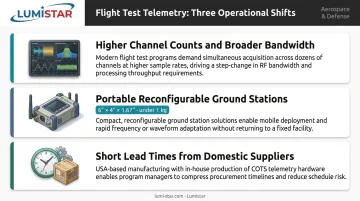
Three operational shifts are reshaping what flight test programs demand from their telemetry suppliers:
- Higher channel counts and broader bandwidth — hypersonic vehicles, next-generation fighters, and eVTOL aircraft push parameter counts per flight well beyond legacy baselines, with tighter thermal and vibration constraints to match
- Portable, reconfigurable ground stations — programs now expect hardware that moves between forward locations and test articles without procurement action; Lumistar's LS-28-DRSM delivers a full ground station function in a 6" × 4" × 1.67" package under 1 kg, with firmware-based personalities that swap without hardware changes
- Short lead times from domestic suppliers — constrained budgets and compressed schedules make delivery delays genuinely damaging, not merely inconvenient
Lumistar maintains component inventory specifically to hit customer delivery timelines, with a dedicated delivery contact (Brandt Barsby, (760) 431-2181 x116) and unlimited post-delivery technical support included on every order.
Frequently Asked Questions
How big is the US aerospace defense telemetry market?
The US represents the largest national share of a global market valued at approximately USD 2.23 billion in 2026. North America as a region holds roughly 35.7% of global revenue, driven by the world's largest defense budget, 23 major test range sites, and extensive space and missile programs. For US-specific figures, current market research from Mordor Intelligence provides the most up-to-date breakdown.
What is telemetry in aerospace defense?
Aerospace and defense telemetry is the automated, real-time measurement and wireless transmission of data—speed, temperature, pressure, structural loads—from aircraft, missiles, spacecraft, or UAVs to ground stations. Engineers use this data to verify performance against design specifications and make safety-critical decisions during test flights.
Who are the leaders in the US aerospace defense market?
At the prime integrator level, Lockheed Martin, L3Harris Technologies, RTX Corporation (Raytheon), and BAE Systems are among the most prominent. Specialized component manufacturers supply IRIG 106-compliant transmitters, receivers, bit synchronizers, and ground station hardware to both primes and federal test range operators.
What is the outlook for the US aerospace defense industry in 2026?
Demand for advanced telemetry systems remains solid heading into 2026. Elevated defense appropriations, active hypersonic and next-generation aircraft programs, growing commercial space launch activity, and ISR platform modernization all sustain growth. The DoD's USD 179 billion FY2026 RDT&E request and specific T&E range funding lines provide concrete budget support.
What are the main drivers of aerospace telemetry market growth?
Five factors are driving growth in this market:
- Hypersonic vehicle programs requiring plasma-sheath-resilient, high-bandwidth telemetry
- Satellite constellation expansion demanding upgraded ground infrastructure
- ISR platform modernization pushing for higher-bandwidth data links
- UAV proliferation across military and commercial applications
- SDR and miniaturization advances accelerating hardware refresh cycles
What role does flight test telemetry play in the broader aerospace and defense market?
Flight test telemetry enables aircraft and weapons system certification by capturing and transmitting hundreds to thousands of data parameters per flight. It's a specialized sub-segment where IRIG 106 compliance, compact SWaP profiles, and reliable ground station infrastructure are non-negotiable requirements that grow more demanding with each new test article.