RF telemetry is discussed across many industries, from medical monitoring to wildlife research. But nowhere are the operational stakes higher than in aeronautical and aerospace flight test, where a broken data link doesn't just mean a missed measurement — it can mean an inconclusive test point, a repeat flight, or a safety blind spot during the most critical phase of a program.
This article explains how RF telemetry systems work, where they are applied across flight test and range operations, and why their specific advantages translate directly into mission outcomes.
Key Takeaways
- RF telemetry systems wirelessly transmit measurement data from an airborne test article to a ground receiving station in real time
- In aeronautical flight test, RF telemetry is the primary method for monitoring vehicle health, performance, and safety parameters during live flight
- Real-time data visibility lets ground teams act on maneuver, envelope, and abort decisions during flight — not after it
- Modern systems have shrunk from 8-foot, 250 kg rack installations to handheld units under 1 kg, changing how test programs are resourced
- Compliance with IRIG Standard 106-24R1 ensures interoperability across RCC member ranges and defense programs
What Is an RF Telemetry System?
An RF telemetry system uses radio frequency signals to automatically collect measurements from a source — typically a flight test vehicle — and transmit them wirelessly to a receiving station for real-time monitoring and recording.
In flight test contexts, "RF telemetry system" refers to the full chain, not a single device.
The End-to-End Chain
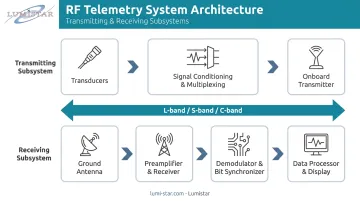
Per the RCC Telemetry Applications Handbook (RCC 119-06), the architecture spans two subsystems:
Transmitting subsystem:
- Transducers measuring physical parameters
- Signal conditioning and multiplexing hardware
- Onboard transmitter broadcasting encoded data
Receiving subsystem:
- Ground antennas capturing the RF signal
- Preamplifiers and receivers
- Demodulators and bit synchronizers recovering clock and data
- Data processors, recorders, and real-time displays
The RF channel connecting these two subsystems — described in RCC 120-21 as the aeronautical mobile telemetry RF link — operates across L-band, S-band, and C-band frequencies depending on the program.
What This Enables
The operational purpose of this chain is straightforward: it lets engineers and safety officers observe what is happening inside and around a test vehicle without being physically connected to it. Across distances and environments where wired connections are physically impossible, RF telemetry is the only viable path.
That full chain is what Lumistar's product line is built around. It spans airborne receivers and the LS-28-DRSM modular receiver/combiner through demodulators, bit synchronizers, PCM decommutators, and the LS-68-M multi-channel processing system — covering every stage from RF reception to data display and archiving.
Key Uses and Applications of RF Telemetry Systems
RF telemetry systems serve as the primary data link across the full breadth of aeronautical and aerospace flight test. The applications below reflect where the technology is operationally critical, not just convenient.
Crewed and Uncrewed Aircraft Flight Test
This is the core application. Flight test engineers need continuous measurement of structural loads, engine performance, avionics states, and control surface deflections during live flight — data that cannot wait for post-flight retrieval when real-time decisions depend on it.
Key parameters captured via RF telemetry during flight test include:
- Structural load and strain measurements across airframe stations
- Engine performance data including thrust, temperature, and fuel flow
- Control surface deflections and actuation response times
- Avionics bus states and system health flags
IRIG Standard 106-24R1 (published January 2025) applies directly to this domain, covering aeronautical telemetry for both manned and unmanned aircraft at RCC member ranges.
Missile and Rocket Range Operations
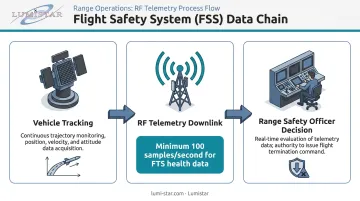
RCC 319-25 defines a Flight Safety System (FSS) as consisting of a Flight Termination System (FTS), a method to track the vehicle, and a method to receive vehicle status data. That last element — the real-time status data link — is an RF telemetry function.
Range safety officers use downlinked telemetry to monitor trajectory and system health. Flight termination decisions, where applicable, depend on a continuous and reliable RF data stream. RCC 319-25 specifies that continuously changing FTS outputs, including receiver signal strength and battery voltage, require a minimum telemetry data rate of 100 samples per second.
Defense and UAV Programs
For UAVs, remotely piloted vehicles, and weapons systems, RF telemetry is frequently the only viable path for real-time data acquisition. NASA's AirSTAR subscale research aircraft used an L-band telemetry uplink and S-band telemetry downlink to connect the aircraft to a ground-based flight control system, demonstrating how RF telemetry supports full flight control and monitoring of uncrewed test articles.
Lumistar's LS-28-DRSM airborne receiver, ruggedized for severe airborne conditions and operating across 200 MHz to 7 GHz, is designed and qualified for integration into UAV, missile, and chase aircraft configurations.
Civil and Commercial Certification Programs
Aircraft manufacturers use RF telemetry during envelope expansion and structural testing to capture parameters at volumes and granularities that onboard flight data recorders cannot match. The gap is most pronounced for high-rate structural and loads data, where certification programs require sample densities that embedded recorders simply aren't designed to handle.
Space and Orbital Applications
Space agencies including NASA use RF telemetry to transmit spacecraft health and status data over vast distances. Deep-space missions routinely operate with one-way light-time delays measured in minutes, yet the underlying telemetry link architecture mirrors what flight test ranges use — the same framing standards, the same bit synchronization principles, applied at interplanetary scale.
Key Advantages of RF Telemetry Systems
The advantages below are grounded in operational outcomes — the ones flight test engineers, program managers, and safety officers actually measure.
Real-Time Flight Parameter Visibility
RF telemetry gives ground-based engineers continuous, low-latency access to data channels across the full test article simultaneously while the aircraft is airborne. Parameters like structural strain, vibration, temperature, pressure, and avionics state cannot wait for post-flight download when decisions need to be made during the flight.
Real-time visibility enables immediate action:
- Maneuver modifications called by the test conductor based on live loads data
- Envelope expansion or retraction decisions made in real time rather than between flights
- Abort criteria applied the moment a parameter approaches a limit — not after landing
Each wasted test point requires a repeat flight, adding cost, schedule exposure, and renewed risk to the test article and crew.
Key performance indicators affected:
- Test point completion rate per flight
- Number of repeat flights required
- Time-to-first-data post-takeoff
- Ground station data latency
Operational Range and System Flexibility
RF telemetry eliminates the physical constraints of wired connections. Test vehicles can operate across their full flight envelopes — extended range, high altitude, high-speed corridors — while maintaining a continuous data link to the ground station.
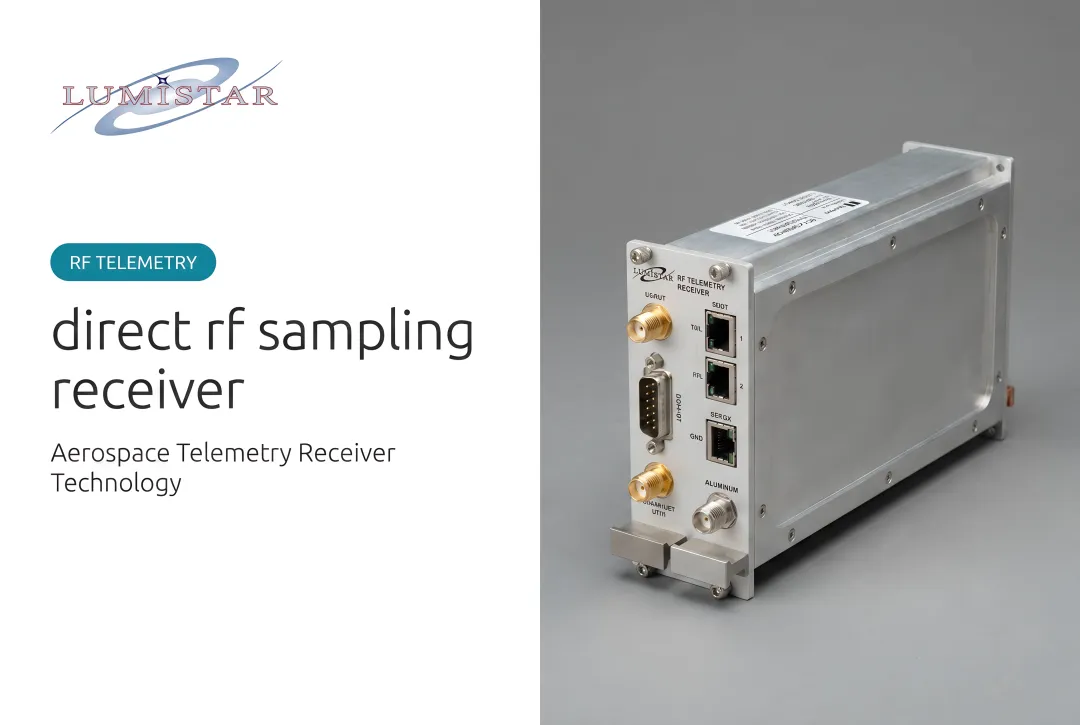
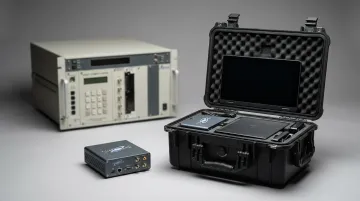
Ground station hardware has shrunk dramatically over the past two decades. Systems that once filled 8-foot racks, weighed 250 kg, and consumed several thousand watts have been replaced by units like Lumistar's LS-28-DRSM, which measures 6" × 4" × 1.7", weighs under 1 kg, and draws approximately 45 watts. The portable LS-28-DRSM-P1 packages a complete dual-channel ground station into a 15-pound IP-67 rated case with up to 10 hours of battery life.
This size reduction has direct operational consequences:
- Forward-deployed programs no longer depend on fixed range infrastructure
- Off-range test events can be supported with portable equipment carried on commercial flights
- Mobile configurations integrate directly into tracking antenna pedestals or vehicle-mounted platforms
- Setup time shrinks from days to hours
That portability is especially valuable in long-range missile programs, extended-standoff UAV operations, and test campaigns run at temporary or non-primary locations — scenarios where fixed infrastructure simply isn't an option.
Safety Assurance and Test Program Risk Reduction
RF telemetry is a safety-critical system in manned flight test. It provides range safety officers and test directors with real-time vehicle health data, supports flight termination systems, and gives ground crews continuous visibility into the test article's condition throughout the flight.
When structural loads approach limits, engine performance degrades unexpectedly, or avionics anomalies appear, the RF telemetry link is how the ground team detects the problem in time to act. Post-flight data retrieval offers no such opportunity.
RCC 319-25 codifies this logic directly: its requirement for FTS health telemetry at 100 samples per second exists because the data rate must support real-time decisions, not just post-flight archival. A reliable RF telemetry link converts a reactive situation into a proactive one.
Key performance indicators affected:
- Safety event response time
- Flight termination decision latency
- Number of test-related incidents
- Flight clearance confidence levels
What Happens Without a Reliable RF Telemetry System
An unreliable or absent RF telemetry link creates problems across three distinct dimensions — operational, safety, and regulatory — and the cost of each compounds the others.
Data gaps during flight mean test points cannot be validated. Each unvalidated point requires a repeat flight, adding cost, schedule delay, and additional exposure of the test article and crew to program risk.
Without a continuous RF data link, range safety officers and test directors lose visibility during critical test phases. An anomaly that would have triggered an abort under telemetry monitoring goes undetected until post-flight analysis — at which point intervention is no longer possible.
The regulatory exposure is equally concrete. RCC 319-25 gives range safety personnel final decision authority over whether technical solutions meet performance requirements, and modifications to approved FTS configurations require affected range approval. Systems that cannot meet applicable telemetry standards create approval barriers that post-processing capability cannot resolve.
How to Get the Most from Your RF Telemetry System
RF telemetry performs best when architected as an end-to-end solution (from the airborne transmitter and antenna through the receiving station, demodulation chain, and data display) rather than assembled from mismatched components. Interoperability across each link, including IRIG 106 compliance, is required for use at RCC member ranges.
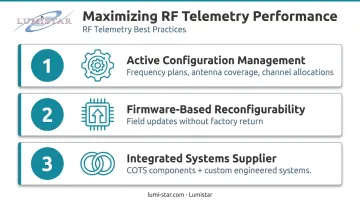
Three practical considerations for maximizing system performance:
Treat configuration as an active program element. Frequency plans, antenna coverage patterns, and data channel allocations should be reviewed and adjusted as test programs evolve. Programs that configure telemetry once and leave it static consistently encounter data quality issues mid-campaign.
Leverage firmware-based reconfigurability. Lumistar's modular architecture, particularly the LS-28-DRSM series, uses firmware-based "personalities" that allow the same hardware platform to be reconfigured for different operational roles — new modulation formats, channel allocations, or deployment scenarios — via field firmware updates, without returning equipment to the factory.
Work with a supplier who offers both components and integrated systems. Component-level flexibility combined with integrated systems expertise reduces integration risk significantly. Lumistar provides both: individual COTS components available from stock, and custom integrated systems engineered to match exact program requirements.
With over 100 years of combined engineering experience in aeronautical telemetry and all products designed and manufactured in the USA, Lumistar's team can configure a ground system around a specific test profile. Unlimited post-delivery technical support is included, giving engineers direct access to application engineers throughout active test campaigns.
Frequently Asked Questions
How does an RF telemetry system work?
An RF telemetry system uses a radio frequency transmitter on the test article to encode and broadcast measurement data. A ground antenna captures that signal, which is then demodulated by receiver hardware, synchronized by a bit synchronizer, and delivered to data processing and display systems in near real time.
What is a radio telemetry system?
A radio telemetry system automatically collects data at a remote or moving location — such as an airborne test vehicle — and wirelessly transmits it to a receiving station for monitoring, recording, and analysis.
What are the different types of telemetry?
The primary categories include:
- RF telemetry — used in flight test and space applications
- Wired telemetry — used in laboratory and ground test settings
- Acoustic/ultrasonic telemetry — used in underwater applications
- Biotelemetry — used in medical monitoring
RF is the dominant form in aerospace and defense flight test.
What is mobile telemetry?
Mobile telemetry refers to RF telemetry systems designed to operate from portable or vehicle-mounted platforms rather than fixed ground stations. Systems like the LS-28-DRSM-P1 enable flight test support at remote or forward-deployed locations without dependence on permanent range infrastructure.
Is a telemetry tracker real?
Yes — telemetry tracking systems are widely used across aerospace, defense, wildlife research, and medical applications. In aeronautical flight test specifically, tracking antennas actively follow the test article throughout its flight envelope to maintain a continuous RF data link with the airborne transmitter.