Introduction
Choosing the wrong RF module can mean a dropped signal at the worst possible moment — whether that's a sensor node losing contact across a warehouse floor or a telemetry link going dark during a critical flight test maneuver. The stakes vary dramatically depending on where you sit on the spectrum of RF applications.
That spectrum is wider than most buyers realize. On one end: compact 433 MHz ASK modules costing under $5, sold in packs of ten on hobbyist marketplaces. On the other: IRIG 106-compliant L-band and S-band telemetry receivers built to survive airborne environments and deliver reliable data from aircraft to ground stations across mission-critical distances.
Both qualify as "RF transmitter and receiver modules." The selection logic between them is entirely different.
This guide covers both ends — and everything in between — with specs, real-world tradeoffs, and a practical framework for matching the right technology tier to your requirements. That includes frequency band selection, modulation schemes, compliance standards, and the distance and environment factors that determine whether a module will hold up when it matters.
Key Takeaways
- RF modules convert data into radio signals and back, enabling wireless links from a few meters to tens of kilometers
- Sub-GHz bands (433 MHz, 900 MHz) maximize range and obstacle penetration; 2.4 GHz trades that range for higher data throughput; L/S-band serves professional aeronautical telemetry
- Selection comes down to four factors: frequency band, output power, receiver sensitivity, and regulatory compliance for your application
- Covered modules range from hobbyist (nRF24L01+, RFM69HCW) and industrial (Digi XBee-PRO 900HP, TI CC1101) up to professional aerospace-grade systems (Lumistar LS-28-DRSM)
What Are RF Transmitter and Receiver Modules?
An RF transmitter module is a compact electronic component that encodes data onto a carrier radio wave and broadcasts it wirelessly via antenna. The receiver module captures that wave, demodulates it, and reconstructs the original data. Together, they form a complete wireless link.
How the link works, at a basic level:
- The transmitter takes input data (digital bits, analog signals, PCM frames)
- It modulates that data onto a carrier signal at a set frequency using a chosen scheme (ASK, FSK, LoRa, PCM/FM, etc.)
- The modulated signal radiates via antenna
- The receiver, tuned to the same carrier frequency, captures the signal and demodulates it
- The original data is reconstructed and passed to downstream processing
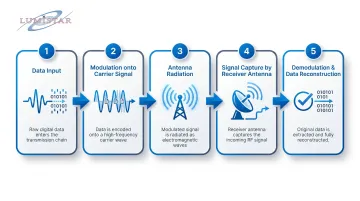
A critical design requirement: both modules must share compatible frequencies and compatible protocols. A 915 MHz transmitter won't communicate with a 915 MHz receiver running a different packet format — matched frequency is necessary but not sufficient.
That protocol complexity is one reason professional RF telemetry commands significant investment. The aerospace and defense telemetry market was valued at USD 1.4 billion in 2022 and is projected to reach USD 2.0 billion by 2027 at a 6.9% CAGR. Defense test programs drive much of that growth, where regulatory qualification adds both cost and schedule pressure to system selection.
Types of RF Transmitter and Receiver Modules
By Frequency Band
| Band | Typical Frequencies | Primary Use Cases |
|---|---|---|
| Sub-GHz | 315, 433, 868, 915 MHz | IoT sensors, remote control, home automation |
| 2.4 GHz ISM | 2400–2483.5 MHz | RC, FPV drones, wireless sensor networks |
| L-Band | 1435–1540 MHz, 1710–1850 MHz | Aeronautical telemetry (IRIG 106) |
| S-Band | 2200–2400 MHz | Flight test telemetry, defense programs |
| C-Band | 4400–5250 MHz | High-data-rate aerospace telemetry |
Regulatory Note: The 902–928 MHz and 2.4 GHz bands are permitted under FCC Part 15.247 for FHSS and digital modulation, with conducted power up to 1 W (antenna gain restrictions apply). The 315 MHz and 433 MHz bands fall under separate Part 15 Subpart C provisions, which impose tighter power and duty-cycle limits.
By Modulation Type
- ASK (Amplitude Shift Keying) — simple, low-cost; susceptible to noise; common in basic 433 MHz short-range commercial modules
- FSK/GFSK — better noise immunity; used in IoT modules like the RFM69HCW
- LoRa (chirp spread spectrum) — optimized for long-range, low-power IoT at 0.3–50 kbps; not suited for high-rate links
- PCM/FM, SOQPSK-TG, ARTM-CPM — professional aeronautical telemetry modulations governed by IRIG 106 Chapter 2, used in L-band and S-band flight test systems
By Link Configuration
- Simplex — one-way only (TX or RX); simple alarm transmitters, basic remote sensors
- Half-duplex — alternating TX/RX; covers most short-range sensor nodes and low-cost module pairs
- Full-duplex — simultaneous TX and RX; required for real-time bidirectional control links and some professional telemetry configurations
Best RF Transmitter and Receiver Modules
These selections span hobbyist, industrial, and professional aerospace tiers — evaluated on range, data throughput, reliability, protocol support, and application fit.
Nordic Semiconductor nRF24L01+
The nRF24L01+ is the go-to 2.4 GHz transceiver for makers and embedded engineers worldwide. Its SPI interface drops directly into Arduino, ESP32, and Raspberry Pi projects with minimal wiring, and the module is cheap enough to deploy in multiples across a sensor network.
Key specs:
| Parameter | Value |
|---|---|
| Frequency | 2.4–2.4835 GHz ISM |
| Max Data Rate | 2 Mbps (also 1 Mbps, 250 kbps) |
| Typical Range | ~100 m open air with antenna |
| Power-Down Current | 900 nA |
Beyond the specs, the Enhanced ShockBurst protocol handles auto-acknowledgment and auto-retransmit at the hardware level, freeing firmware from managing packet reliability. The six-pipe MultiCeiver architecture lets one receiver listen to up to six transmitters simultaneously — useful for multi-node wireless sensor layouts.
Where it falls short: the 2.4 GHz band is crowded, and the nRF24L01+ has no built-in encryption. For applications handling sensitive data, encryption must be handled at the application layer.
HopeRF RFM69HCW
The RFM69HCW occupies the practical middle ground between basic ASK modules and industrial-grade hardware. Available in 315, 433, 868, and 915 MHz variants, it's a staple in the Adafruit Feather ecosystem and compatible with Arduino and MicroPython out of the box.
Key specs:
| Parameter | Value |
|---|---|
| Frequency Options | 315 / 433 / 868 / 915 MHz |
| Max Data Rate | 300 kbps |
| Output Power | Up to +20 dBm |
| Receiver Sensitivity | ~−120 dBm |
| Encryption | Hardware AES-128 |
Three features set the HCW variant apart from cheaper ASK modules:
- +20 dBm output gives it meaningful range without an external amplifier
- Hardware AES-128 encryption suits projects where data security matters
- Built-in packet engine with CRC checking handles link-layer reliability without software overhead
Sleep modes drop current low enough for battery-powered deployments lasting months.
Digi XBee-PRO 900HP
Digi International has been building industrial wireless modules for decades, and the XBee-PRO 900HP reflects that experience. It's built for deployments where network reliability, certification, and long-term vendor support matter as much as raw range.
Key specs:
| Parameter | Value |
|---|---|
| Frequency | 902–928 MHz ISM |
| Max Range (LOS) | Up to 45 km with high-gain directional antenna |
| Range with 2.1 dBi dipole | ~14.5 km at 10 kbps |
| Networking | DigiMesh peer-to-peer / mesh |
| Certifications | FCC ID MCQ-XB900HP, IC certified |
One caveat on the range figure: the 28-mile / 45 km claim requires a high-gain directional antenna and unobstructed line-of-sight. Real-world deployments with standard dipoles and moderate obstacles will achieve significantly shorter range. Run a proper link budget before designing a system around that headline number.
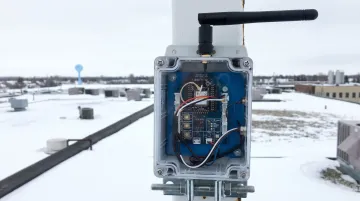
DigiMesh self-healing mesh networking is the feature that justifies the price premium for industrial applications — nodes can reroute around failures without manual intervention, which is essential for remote monitoring infrastructure where physical access is difficult.
Texas Instruments CC1101
The CC1101 is an RF engineer's module: highly configurable, low-cost at the component level, and available either as a bare IC or breakout board. It covers an unusually wide sub-GHz frequency range across three bands (300–348 MHz, 387–464 MHz, and 779–928 MHz), making it adaptable to different regional regulatory requirements.
Key specs:
| Parameter | Value |
|---|---|
| Frequency Range | 300–928 MHz (configurable) |
| Modulation Support | 2-FSK, 4-FSK, GFSK, OOK, MSK |
| Max Data Rate | Up to 600 kbps |
| Supply Voltage | 1.8–3.6 V |
| Output Power | Up to +12 dBm |
The Wake-on-Radio function targets ultra-low duty cycle applications: the chip wakes on detected RF activity without a host microcontroller polling it, enabling years-long battery life in remote sensors. Programmable modulation options make it a strong fit for custom wireless product development where regulatory flexibility across markets is a requirement.
Lumistar LS-28-DRSM Series (Professional Aeronautical Telemetry)
The LS-28-DRSM series operates in a fundamentally different category from the modules above. Where the nRF24L01+ handles sensor packets, the LS-28-DRSM handles real-time telemetry from aircraft during active flight test programs.
Lumistar, Inc. (San Marcos, CA) has focused exclusively on the aeronautical telemetry market since 2000. The LS-28-DRSM is their fourth-generation modular receiver and signal processing platform. Its single hardware architecture with firmware-based personalities means one unit covers functions that previously required multiple separate hardware boxes.
Physical specs that matter for flight test:
| Parameter | Value |
|---|---|
| Dimensions | 6.00″ × 4.00″ × 1.67″ |
| Weight | Under 1 kg (max 2.1 lbs) |
| Power | 45–50 W, single rail +9 to +42 VDC |
| Max Data Rate | Up to 60 Mbps |
Frequency bands supported:
- Lower L-Band: 1435–1540 MHz
- Upper L-Band: 1710–1850 MHz
- S-Band: 2200–2400 MHz
- NATO E-Band: 2185–2485 MHz
- C-Band: 4400–5250 MHz
- P-Band: 215–320 MHz
- Custom bands 200 MHz to 6 GHz available on request
Demodulation formats:
PCM/FM (multi-symbol and single-symbol), SOQPSK-TG, Multi-H CPM, BPSK, QPSK, OQPSK, AQPSK, AUQPSK, PCM/PM, Analog FM (NTSC/PAL), and Subcarrier — covering IRIG 106 Chapter 2 and Chapter 4 requirements including all six IRIG 106 LDPC codes.
Application Domain:
| Parameter | Value |
|---|---|
| Application Domain | Aeronautical / Aerospace Flight Test, Defense, Federal Test Ranges |
| Compliance | IRIG 106 Class I and II; ARTM Tier 0, 1, and 2 |
| CAGE Code | 718V9 |
| Key Advantage | Firmware-based personalities; hand-portable form factor; RF to Ethernet (IRIG-218 / CH10) in a single unit |
The form factor reduction is dramatic: legacy ground stations for comparable applications ran 8 feet tall, weighed 250 kg, and consumed thousands of watts. The LS-28-DRSM handles equivalent functionality in a unit the size of a hard drive. The portable P1 version — rated IP-67, ATA Spec 300, and Military Standard C-4150J — can be carried onto aircraft as cabin baggage and stowed in an overhead bin.
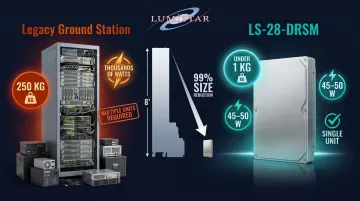
The system was used during Virgin Orbit's LauncherOne Launch Demo 2 in January 2021, providing real-time telemetry capture throughout the full flight profile, including orbit insertion confirmation.
How We Chose the Best RF Transmitter and Receiver Modules
Application Fit Before Raw Specs
The most common procurement mistake is selecting a module based on headline range or data rate without accounting for the actual RF environment, antenna system, regulatory band, and integration complexity.
A module that looks excellent on a spec sheet can fail in practice — running in a congested 2.4 GHz environment without interference mitigation, or claiming range that assumes a high-gain directional antenna your application can't support.
Frequency Band Suitability
- Sub-GHz (433, 868, 915 MHz): Better obstacle penetration, longer range at lower data rates; suitable for IoT mesh networks and remote monitoring
- 2.4 GHz: Higher throughput, shorter range, more crowded band; suited for RC, FPV, and high-data-rate sensor hubs
- L-Band / S-Band: Required for IRIG 106-compliant aeronautical telemetry; specific AMT allocations (e.g., 2200–2390 MHz) require NTIA coordination for federal programs
Using the wrong band isn't just a performance issue — it can result in regulatory violations or interference with protected allocations.
Technical Proven Performance Factors
Band selection narrows the field. Within a given band, three factors determine real-world link performance:
- Modulation type — determines the range-vs-data-rate tradeoff; PCM/FM and SOQPSK-TG deliver better spectral efficiency at high data rates than basic FSK
- Link budget — output power and receiver sensitivity together determine achievable range; neither figure alone tells you much
- Built-in reliability features — hardware AES encryption, CRC, auto-retransmit, and forward error correction (LDPC in IRIG 106 systems) determine how the link holds up when conditions degrade
Ecosystem and Long-Term Support
Hardware performance only matters if the surrounding ecosystem supports it. What that means varies significantly by application:
- Hobbyist and IoT modules: Software library availability, development board compatibility, and active community support
- Professional aerospace programs: CAGE codes for federal procurement, IRIG 106 certification documentation, and a supplier with a documented support commitment beyond initial delivery
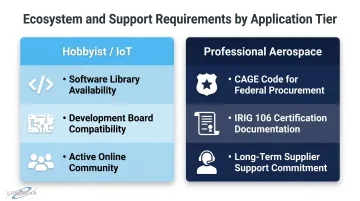
Lumistar's engineering team carries over 100 years of combined telemetry experience and provides unlimited post-delivery technical support — with a policy of connecting callers directly to an application engineer on the first attempt. For flight test programs where schedule slippage has real cost consequences, that access is as tangible a procurement factor as the hardware specifications.
Conclusion
An nRF24L01+ is an excellent choice for a wireless sensor network; it won't serve a flight test ground station. A Lumistar LS-28-DRSM is built for IRIG 106-compliant telemetry reception; it's not what you need for a hobbyist RC project. The module that's right for your application is the one sized to your actual operational tier — nothing more, nothing less.
Before procurement, assess your actual requirements:
- Frequency compliance — which band is legally available for your application and region?
- Data throughput — what bit rate does your data source require, with margin?
- Environmental conditions — indoor, outdoor, airborne, or ruggedized field deployment?
- Size and power constraints — especially relevant for airborne or mobile configurations
- Support requirements — does this need to work for ten years with manufacturer backing?
Once those requirements are defined, the field narrows quickly. For engineers and program managers in aeronautical flight test, defense, or federal test range programs requiring IRIG 106-compliant telemetry systems, Lumistar's team is available to discuss your specific configuration. Reach out via sales@lumistar.net or call 760-431-2181.
Frequently Asked Questions
How do RF transmitter and receiver modules work?
The transmitter modulates data onto a carrier radio wave at a set frequency and broadcasts it via antenna. The receiver, tuned to the same frequency, captures the signal, demodulates it, and reconstructs the original data. Both devices must share compatible frequencies and communication protocols — matched frequency alone is not sufficient for a working link.
What are the different types of RF modules?
Main categories include simple ASK modules (433 MHz, hobbyist use), FSK/GFSK transceivers for IoT, LoRa modules for long-range low-power applications, 2.4 GHz modules for high data rate consumer and embedded use, and professional L-band/S-band PCM/FM receivers for aerospace and flight test applications compliant with IRIG 106.
What is the range of an RF transmitter and receiver?
Range varies widely by frequency, output power, antenna, and environment. Basic 433 MHz ASK modules typically cover 20–100 m, while the Digi XBee-PRO 900HP can reach 45 km line-of-sight with a high-gain directional antenna. Professional aeronautical telemetry systems like the LS-28-DRSM are designed for reliable airborne-to-ground links across full flight test mission profiles.
What are common RF module applications?
Common applications span a wide range of industries:
- Home automation, IoT sensor networks, and keyless entry
- RC and FPV drone control
- Industrial SCADA and remote monitoring
- Medical telemetry
- Aeronautical flight test telemetry, UAV test programs, and defense test range data acquisition
Can RF signals penetrate walls?
Lower frequencies (433 MHz, 900 MHz) penetrate walls more effectively than 2.4 GHz due to longer wavelengths. However, research comparing 915 MHz and 2.4 GHz propagation confirms that concrete, metal structures, and dense materials still attenuate all RF signals significantly. Line-of-sight operation delivers the best link performance regardless of frequency.
Do both the transmitter and receiver need antennas?
Yes. Both sides require antennas to radiate and capture electromagnetic waves. Operating a transmitter without a proper antenna — or with a severely mismatched one — dramatically reduces range and can damage the output stage of the transmitter. Antenna design, gain, polarization, and placement are critical components of overall link budget calculation.