The S-band has become the standard for most U.S. aeronautical telemetry work, and for good reason. It occupies a practical middle ground in the microwave spectrum — enough bandwidth for modern flight test data rates, favorable propagation characteristics, and decades of established ground infrastructure at every major federal test range.
This article covers what the S-band is, how S-band telemetry transmitters work, why flight test programs depend on them, and what to evaluate when selecting one for your program.
Key Takeaways
- S-band spans 2–4 GHz (IEEE); U.S. aeronautical telemetry uses 2200–2395 MHz per IRIG 106
- SOQPSK-TG delivers ~2x the spectral efficiency of legacy PCM/FM — the preferred modulation for new programs
- S-band dominates flight test telemetry because of ground infrastructure investment, not propagation physics alone
- IRIG 106 compliance is mandatory on U.S. federal test ranges — non-compliant transmitters simply won't be authorized
- SWaP is the binding constraint for most airborne applications — modern transmitters now fit in hand-held form factors under 1 kg
What Is the S-Band? Frequency Range and Key Characteristics
Per IEEE Standard 521-2019, the S-band spans 2 to 4 GHz, with a free-space wavelength of roughly 7.5 to 15 cm. It sits between L-band (1–2 GHz) and C-band (4–8 GHz) in the microwave spectrum.
For aeronautical telemetry specifically, the relevant sub-range is narrower. IRIG 106-22 Chapter 2 defines two segments:
- Lower S-band: 2200–2300 MHz
- Upper S-band: 2310–2395 MHz
The NTIA confirms that 2200–2290 MHz is federally allocated for mobile service including aeronautical telemetry, with DoD holding the majority of frequency assignments in this band.
Why S-Band Works for Telemetry
S-band offers a practical balance that adjacent bands don't quite match:
- Less rain fade than X-band or Ku-band, keeping links stable in adverse weather
- Better obstacle penetration than higher microwave bands
- Adequate bandwidth for data rates from tens of kbps to tens of Mbps
- Mature antenna technology — both airborne and ground-side hardware is well-developed
A 2010 flight test study from Edwards AFB measured S-band link availability at 93.06% compared to 91.91% for C-band at 5 Mbps — comparable performance, with the dominant impairment being multipath rather than atmospheric absorption. S-band's dominance in flight test comes largely from decades of accumulated ground infrastructure investment, not a fundamental physics advantage over adjacent bands.
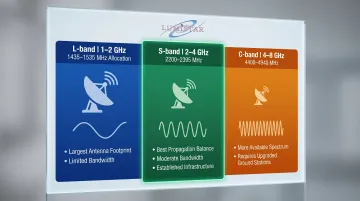
The table below compares S-band against adjacent telemetry bands across the key operational trade-offs:
| Band | IEEE Range | Telemetry Allocation | Key Trade-off |
|---|---|---|---|
| L-band | 1–2 GHz | 1435–1535 MHz | Largest antennas; limited bandwidth |
| S-band | 2–4 GHz | 2200–2395 MHz | Best balance of propagation, bandwidth, and infrastructure |
| C-band | 4–8 GHz | 4400–4940 MHz | More spectrum; requires upgraded ground stations |
How S-Band Telemetry Transmitters Work
The basic signal chain follows a consistent architecture: a data acquisition system feeds baseband PCM data to the transmitter, which modulates it onto an S-band carrier, amplifies it, and radiates it through an airborne antenna toward a ground station.
Modulation: Why SOQPSK-TG Has Taken Over
IRIG 106-22 Chapter 2 specifies three approved modulation schemes for aeronautical telemetry:
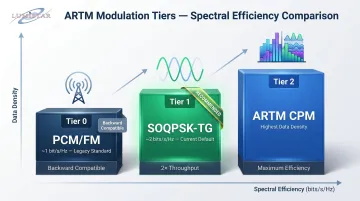
- PCM/FM (ARTM Tier 0) — the legacy standard, approximately 1 bit/s/Hz spectral efficiency
- SOQPSK-TG (ARTM Tier 1) — shaped offset QPSK, approximately 2 bits/s/Hz
- ARTM CPM (ARTM Tier 2) — quaternary continuous phase modulation for the highest data density
All three are constant-amplitude modulations, which lets power amplifiers run in full saturation — the most efficient operating mode. SOQPSK-TG has become the default for new programs because it roughly doubles the data throughput of PCM/FM within the same channel bandwidth while remaining backward-compatible with existing receiver infrastructure.
Power Amplifiers and the SWaP Reality
Solid-state power amplifiers (SSPAs) using GaN technology are now standard in airborne S-band transmitters. IRIG 106-22 caps output power at 25 watts, but most airborne units operate well below that ceiling — typically 2 to 10 watts — because each additional watt of output adds to three tightly budgeted resources on any test article:
- Thermal load — more heat requires additional dissipation mass or active cooling
- Airframe weight — directly affects flight envelope and fuel budget
- DC power draw — competes with avionics, sensors, and recording systems
Getting the power level right requires a proper link budget: too little and you lose data at the worst possible moment; too much and you've burned mass and power budget unnecessarily.
Antennas and Channel Selection
Airborne telemetry transmitters typically drive blade antennas or conformal patch antennas to achieve near-hemispherical coverage. Directional gain is traded for wide angular coverage so the ground station maintains lock through maneuvers — exactly the coverage geometry flight test operations require.
For frequency selection, IRIG 106-22 defines channel assignments in 0.5 MHz steps across the 2200–2395 MHz range. Modern transmitters use programmable synthesizers to tune to assigned channels. On busy test ranges where multiple aircraft fly simultaneously, precise frequency coordination is mandatory — and synthesizer-based tuning makes that coordination straightforward.
S-Band Telemetry in Aeronautical and Flight Test Applications
The lower S-band is the default for U.S. flight test telemetry because the regulatory framework, data rates, and ground infrastructure all align there. The FCC and NTIA have specifically allocated this spectrum for aeronautical mobile telemetry, and every major federal test range — Edwards AFB, Eglin AFB, and White Sands Missile Range — operates S-band tracking antennas as baseline capability.
Platforms That Carry S-Band Transmitters
The range of airborne platforms is wide, each with different SWaP constraints:
- Fixed-wing test aircraft — more volume available, but integration still demands compact hardware
- Rotary-wing platforms — vibration and shock requirements drive ruggedization needs
- UAVs — often the tightest SWaP constraints; every gram and milliwatt counts
- Missiles and munitions — extreme shock and acceleration loads, very limited volume
- Sounding rockets — NASA's sounding rocket program uses S-band downlinks in the 2200–2395 MHz range almost exclusively, with transmitter output from 2 to 20 watts
The Real-Time Link Architecture
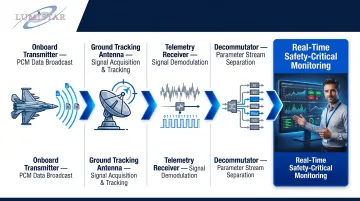
The standard flight test telemetry link works like this:
- Onboard transmitter broadcasts PCM data on an assigned S-band channel
- Ground station's directional tracking antenna acquires and follows the test article
- Telemetry receiver demodulates and bit-synchronizes the signal
- Decommutator separates parameter streams
- Flight test engineers view safety-critical parameters in real time
Every element of transmitter performance — output power, modulation fidelity, spectral compliance — directly affects whether engineers can do their jobs at step five. A signal that drops out during a critical test point isn't recoverable.
IRIG 106: The Non-Negotiable Standard
IRIG 106 is the Inter-Range Instrumentation Group standard governing telemetry systems on U.S. government test ranges. It specifies modulation schemes, frequency plans, data formats, and spectral masks. Section 2.1 of IRIG 106-22 states plainly that "efficient use of available spectrum is mandatory" and that non-conforming systems require specific justification — use is "highly discouraged."
If your transmitter isn't IRIG 106 compliant, it won't be authorized to operate on a federal range. The requirement exists to protect shared spectrum access for every program operating in the band.
That compliance requirement shapes every design decision for range-qualified hardware. Lumistar's transmitter product line — including the LS-18 and LS-19 series — is built to IRIG 106 Class I and Class II compliance, supporting ARTM Tier 0 (PCM/FM), Tier 1 (SOQPSK-TG), and Tier 2 (Multi-H CPM) modulation formats across the 2200–2395 MHz band.
Key Applications of S-Band Telemetry Transmitters
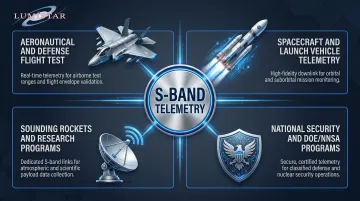
S-band telemetry appears across a broader range of programs than its frequency allocation alone might suggest. Four application areas drive the bulk of demand.
Aeronautical and Defense Flight Test
This is the core use case. Aircraft performance monitoring, structural loads measurement, stores separation, weapons system verification, and UAV development all depend on streaming sensor data to ground stations in real time. S-band's combination of reliable propagation, IRIG 106-compliant waveforms, and mature ground infrastructure makes it the default choice for most flight test ranges.
Spacecraft and Launch Vehicle Telemetry
S-band has been the backbone of space TT&C since NASA's Unified S-Band (USB) system for Apollo, which consolidated voice, video, telemetry, command, and tracking onto a single carrier. The USB uplink ran at 2025–2120 MHz; the downlink at 2200–2290 MHz. That architecture shaped nearly every subsequent human spaceflight program, and S-band TT&C remains embedded in current launch range infrastructure.
Sounding Rockets and Research Programs
Almost all sounding rocket telemetry uses S-band downlinks in the 2200–2395 MHz range, with SOQPSK modulation enabling data rates exceeding 20 Mbps. Ground stations at Wallops, White Sands, Poker Flat, and Andøya all support this band, giving research programs a well-distributed infrastructure network across the US and internationally.
National Security and DOE/NNSA Programs
S-band has also moved into stockpile stewardship and national security instrumentation. LANL's iHiFi project (LA-UR-22-21030) documents a lower S-band transmitter with 10 W output and SOQPSK/OQPSK modulation — confirmation that bandwidth-efficient S-band telemetry is now standard even in historically conservative defense domains. The shared frequency environment with decades of existing infrastructure keeps integration costs and qualification risk low.
What to Look for When Selecting an S-Band Telemetry Transmitter
IRIG 106 Compliance and Modulation Support
Confirm the transmitter supports PCM/FM, SOQPSK-TG, and ideally ARTM CPM. Verify it meets the spectral mask requirements in IRIG 106-22 Chapter 2, including the center frequency tolerance of ±0.002% and spurious emission limits. If it can't demonstrate range authorization at your intended facility, no other specification matters.
Output Power and Link Budget
Match transmitter power to your actual link geometry. The RCC Document 120-21 RF Handbook provides the framework for calculating link margin given range, antenna gains, and required bit error rate. Key parameters to nail down:
- Maximum slant range from test article to ground station
- Ground antenna gain and noise figure
- Required BER at the ground receiver
- Margins for multipath and pattern nulls in the airborne antenna
Airborne test transmitters typically run 2–10W. The regulatory ceiling is 25W per IRIG 106-22. Over-specifying wastes mass and power; under-specifying risks data loss during the critical test windows you cannot repeat.
SWaP Envelope
For each platform type, the constraints differ:
- Missiles/munitions: Volume is the binding limit — cubic inches matter
- Small UAVs: Mass and DC power dominate; thermal dissipation in a sealed airframe is a real problem
- Test aircraft: More flexibility, but integration into existing avionics architecture still constrains form factor
Solid-state transmitters have cut SWaP figures substantially compared to earlier tube-based designs. Request size, weight, and power consumption data alongside RF performance specs — they're equally important selection criteria.
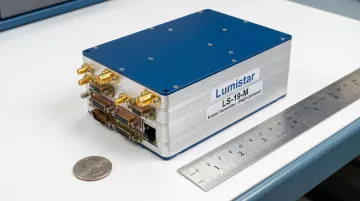
Lumistar's LS-19-M, for example, covers the full 2200–2395 MHz S-band telemetry range in a package measuring 6.0" × 4.0" × 1.67", weighing under 1 kg, with 10W typical power consumption. That's a practical benchmark for evaluating competing units on SWaP.
Reliability, Environmental Ratings, and Support
SWaP figures only matter if the unit holds up in the field. A transmitter failure can ground a program, so evaluate:
- Operating temperature range (−40°C to +85°C is the baseline for serious applications)
- Shock and vibration ratings appropriate to the platform (missiles demand 100 Gs+)
- MIL-STD-461 EMI compliance to protect co-located GPS and avionics
- Meaningful warranty terms and direct access to application engineers
Lumistar backs its products with unlimited post-delivery technical support — customers reach an experienced application engineer on the first call, not a help desk queue. For programs where downtime has real cost, that responsiveness matters.
Integration and Interface Compatibility
Confirm the data input interface before ordering. Common options include RS-422 (the most prevalent PCM data interface in flight test), TTL/LVTTL, and differential RS-422/485. Frequency programming is typically handled via RS-232, USB, or Ethernet TCP/IP on modern units — verify this matches your test article avionics architecture.
Frequently Asked Questions
What is an S-band transmitter?
An S-band transmitter is an RF device that generates and radiates signals in the 2–4 GHz microwave band. In telemetry applications, it encodes instrumentation data onto an S-band carrier and transmits that signal to a ground station for real-time monitoring and recording.
What is the S-band spectrum used for?
S-band applications span aeronautical and spaceflight telemetry, NEXRAD weather radar, airport surveillance radar, satellite TT&C, and consumer devices like 2.4 GHz Wi-Fi and Bluetooth. For professional flight test telemetry, the relevant allocation is the lower S-band from 2200 to 2394 MHz, designated for aeronautical mobile telemetry.
How does an S-band transponder work?
Unlike a telemetry transmitter, which is downlink-only, a transponder is a two-way device: it receives an interrogation signal and automatically replies on a designated frequency. That makes transponders useful for tracking and commanding spacecraft, but airborne flight test systems typically use dedicated transmitters optimized for data downlinking.
What frequency range does S-band telemetry use in flight test?
U.S. aeronautical flight test telemetry operates from approximately 2200 to 2395 MHz, as defined by IRIG 106-22 and allocated by the NTIA for aeronautical mobile telemetry. Specific channel assignments within this range are coordinated by the test range for each program.
What is IRIG 106 and why does it matter for S-band telemetry?
IRIG 106 is the Inter-Range Instrumentation Group standard governing telemetry systems on U.S. government test ranges — covering modulation schemes, frequency plans, data formats, and spectral masks. Compliance is mandatory for any transmitter operated on a federal test range; non-conforming systems require specific justification and are rarely approved.
How does S-band compare to L-band for aeronautical telemetry?
L-band (1–2 GHz) offers slightly better atmospheric propagation and slightly larger antennas. The dedicated aeronautical telemetry allocation in S-band (2200–2395 MHz) provides more available channels and broader ground station infrastructure at U.S. test ranges, making S-band the more common choice for modern flight test programs where ground station compatibility is a practical requirement.