Introduction
Modern military operations generate enormous volumes of data — ISR feeds from unmanned aircraft, real-time command links, logistics coordination, personnel communications. All of it demands continuous, high-bandwidth connectivity across every time zone and operating environment imaginable. Dedicated military satellite systems were never built to handle this scale alone.
The numbers tell the story. The GAO found that DoD spent over $1 billion leasing commercial satellite bandwidth in FY2011 alone — and that was more than a decade ago. Demand has only grown since. Commercial satellite communications (SATCOM) is now an operational dependency embedded in nearly every major U.S. military mission — not a fallback, but a structural requirement.
This article breaks down what commercial SATCOM is, how the U.S. Space Force manages it, which orbit types are involved, and where the DoD's enterprise SATCOM strategy is heading — and why that trajectory matters for anyone working in defense communications or aerospace.
Key Takeaways
- Commercial SATCOM fills bandwidth gaps that military-only constellations cannot cover, especially for UAV feeds, intelligence data, and personnel communications
- The U.S. Space Force's Commercial Satellite Communications Office (CSCO), under Space Systems Command, manages DoD's commercial SATCOM procurement
- Key benefits: global surge capacity, cost efficiency, and multi-orbit resilience through hybrid GEO/MEO/LEO networks
- DoD is shifting from isolated, single-path systems toward an integrated enterprise SATCOM architecture
- Terminals and interoperability remain the primary obstacles slowing that transition
What Is Commercial SATCOM and Why Does the Military Rely On It?
The U.S. military operates its own satellite constellations — MILSTAR, the Defense Satellite Communications System (DSCS), and Wideband Global SATCOM (WGS) — but these purpose-built systems were never sized for the full scope of modern operations. Commercial satellite communications fills that gap: privately owned and operated networks that relay RF signals between ground terminals, providing capacity the military constellations simply weren't designed to absorb.
The Capacity Gap
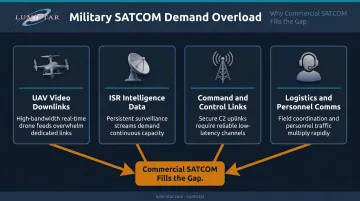
Military satellite systems were purpose-built for a narrower mission set. Contemporary warfighting has outpaced that design. Consider what modern operations actually require:
- Continuous video downlinks from multiple UAVs simultaneously
- High-volume ISR data from manned and unmanned intelligence platforms
- Command-and-control links across theater and strategic headquarters
- Logistics, personnel communications, and administrative traffic
No existing military constellation was sized for all of this at once. Commercial SATCOM fills the gap, and the GAO confirmed DoD depends on it for unmanned aerial vehicles, intelligence functions, and voice/data for military personnel.
The Acquisition Problem
Building new military satellites takes time — a lot of it. A 2025 GAO report on DoD satellite communications cited GAO's broader weapons systems assessment finding that major defense acquisition programs not yet delivering initial capability plan to take over 10 years on average. That timeline applies directly to SATCOM modernization risk: by the time a new military satellite reaches orbit, the operational requirement it was designed to meet has already evolved.
Commercial providers can deploy new capacity far faster. The global satellite industry generated $293 billion in revenue in 2024 — a mature, competitive market spanning multiple frequency bands and orbital regimes. That gives DoD immediate access to proven capacity without carrying the full cost of development or the decade-long wait for a new constellation to reach orbit.
What Commercial SATCOM Is Not
Commercial SATCOM does not replace protected military systems. The GAO is explicit: there is no commercial counterpart to the protected military satellite segment.
Systems like MILSTAR and the Advanced Extremely High Frequency (AEHF) constellation exist precisely because some communications require hardened, encrypted, anti-jam capability that commercial satellites don't provide. Commercial capacity handles unclassified and lower-sensitivity traffic — freeing military satellites for the missions that genuinely need them.
How the U.S. Military Manages Commercial SATCOM Programs
Organizational Structure
The U.S. Space Force's Commercial Satellite Communications Office (CSCO), operating under Space Systems Command (SSC), is the primary entity responsible for acquiring and managing commercial SATCOM services across DoD. This represents a shift away from the earlier Defense Information Systems Agency (DISA)-centered model that preceded it.
On the operational side, Space Delta 8's SATCOM Office provides 24/7/365 payload management through Consolidated SATCOM Systems Expert (C-SSE) organizations. These teams handle wideband, narrowband, protected, and commercial satellite payloads globally — serving as DoD's continuous operational backbone for all SATCOM payload activity.
Active Procurement Programs
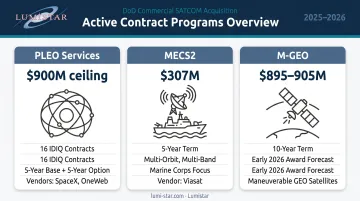
Three programs illustrate the current direction of commercial SATCOM acquisition:
Proliferated LEO (PLEO) Satellite-Based Services — On July 18, 2023, SSC awarded 16 multiple-award IDIQ contracts with a cumulative ceiling of $900 million, a five-year base period, and one five-year option. Vendors include SpaceX, OneWeb Technologies, Hughes Network Systems, and SES Space and Defense. This is the most direct example of how DoD is structuring large-scale commercial SATCOM procurement.
Marine Enterprise Commercial Satellite Services (MECS2) — Valued at a reported $307 million over five years, this award to Viasat covers multi-orbit, multi-band commercial SATCOM for Marine Corps communications.
Maneuverable GEO (M-GEO) — Targeting smaller, more agile geostationary satellites, this program carries a reported scale of $895–905 million over 10 years. SSC has forecasted an early 2026 award.
Why IDIQ Contracts Matter
The Indefinite Delivery Indefinite Quantity (IDIQ) structure is central to how DoD manages commercial SATCOM flexibility. Rather than locking into a single provider, IDIQ allows DoD to onboard multiple vendors, issue task orders competitively, and adapt as new satellite operators and technologies emerge. As commercial LEO constellations proliferate, this structure lets the government capture new capacity without renegotiating from scratch — keeping procurement agile as the commercial market outpaces traditional acquisition timelines.
Key Benefits of Using Commercial Satellite Communications
Global Coverage and Surge Capacity
Commercial constellations provide immediate worldwide coverage that can be tapped without waiting for new military satellite launches. During major combat operations, large exercises, or disaster response, DoD can surge commercial bandwidth to meet demand spikes — then scale back when the mission ends. This elasticity is operationally valuable in ways that fixed military capacity cannot replicate.
Cost Efficiency
Leasing commercial bandwidth costs significantly less per bit than developing and launching dedicated military satellites. The GAO found that DISA-procured commercial SATCOM ran approximately 16% lower in cost than bandwidth procured independently by DoD components — demonstrating both the cost advantage of commercial services and the additional savings from centralized procurement. That efficiency gap matters when DoD estimates annual commercial satellite-service spending in the hundreds of millions of dollars.
Multi-Orbit Resilience
Accessing satellites across GEO, MEO, and LEO simultaneously creates redundant communication pathways. If one link is jammed, disrupted, or degraded, traffic can be rerouted through a different orbit or provider. This is a cornerstone of DoD's resilience thinking — not relying on any single satellite or orbital regime as a single point of failure.
Enabling the Ground Segment
Commercial SATCOM's benefits only materialize when the ground segment can receive and process the signals effectively. For organizations conducting aeronautical flight test and defense range operations, this means having capable, interoperable telemetry receiving equipment at the far end of the satellite link.
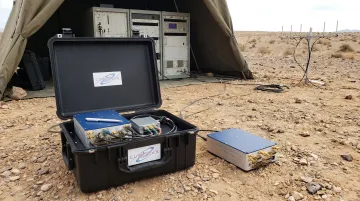
Lumistar, a San Marcos-based telemetry systems manufacturer, produces receiving systems directly relevant to this requirement. The LS-28-DRSM Series is a modular multi-band receiver/combiner that covers the frequency bands used in satellite telemetry operations, including L-band, S-band, C-band, and UHF. Key specifications include:
- Frequency range: 200 MHz to 6 GHz
- Noise figure: 4 dB
- Dynamic range: 120 dB
- Weight: Under 1 kg in its most compact configuration
That's a dramatic reduction from legacy ground stations that once stood 8 feet tall and weighed 250 kg.
For forward-deployed or range operations, the LS-28-DRSM-P1 portable variant fits in an IP-67 rated case weighing roughly 15 pounds. It runs on battery for up to 10 hours and supports IRIG 106, CCSDS, and TMoIP standards, making it compatible with distributed ground architectures used across federal test ranges.
Satellite Orbit Types Used in Military SATCOM
Geostationary Orbit (GEO)
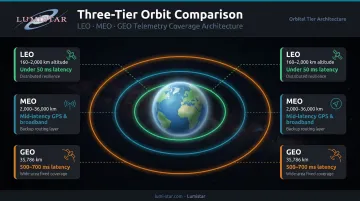
GEO satellites orbit at approximately 35,786 km above the equator, appearing stationary relative to the ground. That fixed position simplifies terminal pointing and enables wide-area coverage from a single satellite — which is why GEO became the traditional choice for military SATCOM.
The tradeoff is latency. Round-trip signal times in GEO typically run 500–700 ms, which matters for latency-sensitive applications. GEO satellites also present large, known, high-value targets. The M-GEO initiative reflects DoD's response: procuring smaller, maneuverable commercial GEO satellites that are harder to track and target while preserving the coverage advantages of the geostationary belt.
Low Earth Orbit (LEO)
LEO constellations operate at 160–2,000 km altitude, delivering latency under 50 ms compared to GEO's 500+ ms, along with higher throughput. The PLEO program's $900 million IDIQ structure signals how seriously DoD is pursuing proliferated LEO services.
The resilience argument for LEO is straightforward: a constellation of dozens or hundreds of small satellites presents far more distributed targets than two or three large GEO birds. Degrading LEO-based communications requires taking out many nodes simultaneously — a much harder problem for an adversary than targeting a handful of known geostationary positions.
Why LEO resilience matters for military planners:
- Distributed architecture means no single point of failure
- Replacing lost nodes is faster and cheaper than rebuilding a GEO satellite
- Adversaries must sustain a far larger, coordinated attack to degrade coverage
Medium Earth Orbit (MEO)
MEO occupies the band between LEO and GEO, roughly 2,000–36,000 km. GPS operates in MEO; some broadband providers use it too. MEO splits the difference between GEO's wide coverage and LEO's low latency. In multi-orbit hybrid architectures, it functions as a backup routing layer — providing an alternative path when GEO or LEO links are congested or degraded.
Challenges and the Move Toward Enterprise SATCOM
Security and Signal Vulnerability
Commercial satellites were not designed with military-grade encryption, anti-jam, or anti-spoofing features. A GAO report on commercial satellite security found that federal reliance on commercial satellites created vulnerabilities that had not received sufficient attention — and that was in 2002, before DoD's commercial SATCOM dependency deepened further.
When DoD uses commercial capacity, security measures shift entirely to the terminal level. That means deploying:
- Encryption and key management at each ground terminal
- Frequency-hopping to resist jamming
- Operational security protocols that vary by mission type
Every layer adds cost and complexity — and the overall security posture is only as strong as ground segment execution.
Integration and Interoperability Barriers
Historically, military radios and terminals were built to connect to one satellite type. Switching from a WGS connection to a commercial LEO service meant acquiring different hardware — a slow, expensive process that doesn't suit dynamic operations.
The GAO identified multi-orbit user terminals as one of the two central obstacles to enterprise SATCOM. Terminals and waveforms must hand off seamlessly between military and commercial satellites across incompatible frequency bands and orbital regimes — a problem that current hardware largely hasn't solved. Until multi-orbit terminals reach scale, the full hybrid SATCOM architecture is constrained at the endpoints.
The Enterprise SATCOM Vision
Closing those terminal gaps is exactly what the enterprise SATCOM vision is designed to address. DoD's goal is to move from isolated, single-path systems to integrated architectures where military satellites, commercial constellations, ground systems, and user terminals operate as a networked whole.
Dynamic spectrum management and automated routing — so traffic finds the best available path without manual intervention — are the near-term engineering priorities driving that transition.
The GAO recommended that DoD report annually to Congress on enterprise SATCOM implementation progress through fiscal year 2030, including outcomes, risks, and opportunities. Those reports will serve as the primary accountability mechanism for whether terminal development, spectrum coordination, and commercial integration actually converge on schedule — or slip.
Frequently Asked Questions
What are the three types of satellite communication?
The three primary orbit types used in satellite communications are geostationary (GEO), medium Earth orbit (MEO), and low Earth orbit (LEO). Each involves trade-offs in coverage area, latency, and signal strength. GEO provides wide coverage with higher latency, while LEO offers lower latency but requires larger constellations to achieve global reach.
Is SATCOM considered RF?
Yes. SATCOM is an RF technology — satellites transmit and receive radio and microwave signals between ground terminals and orbital transponders. Military and commercial SATCOM systems typically operate in UHF, SHF (X-band), EHF, and Ka-band frequency ranges.
What are the benefits of using commercial satellite communications?
The primary benefits are broader coverage flexibility, faster access to new technology, lower costs compared to building dedicated military satellites, and the ability to scale bandwidth capacity quickly to meet surge demands during exercises or combat operations.
What is the difference between military SATCOM and commercial SATCOM?
Military SATCOM systems like MILSTAR and WGS are government-owned and built with hardened anti-jam, encryption, and survivability features for sensitive missions. Commercial SATCOM is privately owned and primarily used for unclassified or lower-sensitivity traffic to supplement military capacity where dedicated systems cannot meet demand.
How does the U.S. Space Force manage commercial satellite communications?
The Commercial Satellite Communications Office (CSCO) under Space Systems Command acquires and manages commercial SATCOM contracts for DoD. Space Delta 8's SATCOM Office handles 24/7 operational payload management across wideband, narrowband, protected, and commercial satellite payloads globally.
What frequency bands do military satellites typically use?
Military satellites primarily operate in UHF (narrowband, mobile users), SHF/X-band (wideband data), and EHF/Ka-band (protected, high-capacity links). Commercial SATCOM adds C, Ku, and Ka-band capacity. DoD requires services across all of these bands to meet its global communications requirements.