Introduction
On June 19, 2019, at 11:35 p.m. GMT, Iran shot down a U.S. Navy RQ-4A Global Hawk BAMS-D surveillance drone operating in international airspace over the Strait of Hormuz. The aircraft was unarmed, flying at high altitude, and worth roughly $200 million. CENTCOM confirmed it was approximately 34 km from the nearest Iranian coast when it was struck — well outside Iranian territorial airspace by the U.S. account.
What downed that drone wasn't a lone missile battery acting independently. It was a network of sensors, command nodes, and interceptors working in coordination — an Integrated Air Defense System.
That shoot-down illustrates the central challenge of modern offensive air operations: penetrating a defended airspace isn't a matter of outrunning one missile battery. It requires defeating a coordinated system — one that detects, tracks, decides, and engages across an entire theater. What follows breaks down exactly how that system works.
Key Takeaways
- An IADS is not a single weapon — it's a networked architecture of sensors, missiles, command nodes, and electronic warfare assets
- "Integrated" is the critical differentiator — it turns isolated batteries into a coherent, mutually supporting defensive system
- Three core processes drive every IADS: air surveillance, battle management, and weapons control
- Modern IADS are designed to remain functional even after individual nodes are destroyed
- SEAD historically accounts for 15–30% of total sorties in major air campaigns — underscoring how seriously air forces treat the IADS threat
What Is an Integrated Air Defense System?
The Formal Definition
Joint Publication 3-01, Countering Air and Missile Threats (published April 21, 2017) defines an IADS as "not a formal system in itself but the aggregate of Service/functional component and agency AMD systems comprising sensors, weapons, C2, communications, intelligence systems, and personnel operating in a theater/JOA under the control of an AADC."
That definition matters because it immediately corrects the most common misconception: most people picture an IADS as a missile launcher or a SAM battery. That's one component. The system itself is the architecture connecting everything together.
"Integrated" Is the Key Word
Air defense — protecting assets from aerial threats — has existed since World War I. What changed over the following decades was the degree to which individual air defense assets were linked into coherent networks. Early systems were service-specific, independently operated, and unable to share data in real time. Modern IADS are none of those things.
The word "integrated" describes a specific technical and organizational achievement:
- Sensors feed detection data into a common picture
- Command nodes process that picture and make engagement decisions
- Shooters receive assignments and execute them as part of a coordinated response
- Electronic warfare assets protect the network and complicate enemy penetration
Fighter aircraft, airborne early warning platforms, ground-based radars, and electronic warfare aircraft all contribute — not just SAM launchers. The integration of these dissimilar assets into a single coherent network is what transforms individual capabilities into a genuine defense system.
Two Sides of the Equation
Military planners operate on both sides of the IADS problem — building systems to defend territory while simultaneously studying how adversaries might attack or suppress those same systems.
- Defensive counterair (DCA): Operating your own IADS to protect territory and assets
- Offensive counterair (OCA): Countering or destroying an adversary's IADS to create freedom of maneuver — the ability to operate aircraft in contested airspace
Understanding both sides is essential. The architectural strengths that make an IADS difficult to penetrate are precisely what offensive planners must account for before committing aircraft to a mission.
The Core Components of an IADS
Sensors: The Eyes of the System
Every IADS begins with detection. Without accurate, timely sensor data, the network has no picture to work from.
The sensor layer typically includes:
- Early warning radars — long-range detection, potentially hundreds of miles out, providing early cueing to the rest of the network
- Fire control radars — precision tracking systems that guide missiles to specific targets
- Passive sensors — detect electromagnetic emissions without broadcasting a signal, making them harder to jam or locate
- Airborne early warning aircraft — extend radar coverage beyond terrain masking and the horizon
- Over-the-horizon radar — enables detection at strategic distances far beyond line-of-sight ground systems
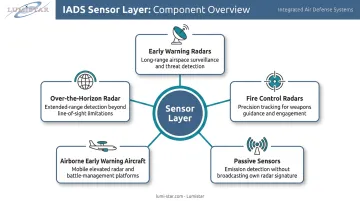
The combination of active and passive sensors creates redundancy. Jamming one sensor type doesn't blind the system.
Surface-to-Air Missiles: The Shooters
SAMs are organized in a layered defense model designed to create overlapping coverage zones at multiple altitudes and ranges.
| Layer | Example System | Engagement Range |
|---|---|---|
| Long-range | S-400 (48N6 missiles) | Up to 250 km |
| Long-range extended | S-400 (40N6 missiles) | Up to 400 km |
| Short-range point defense | Pantsir-S1 | Up to 20 km |
The Pantsir-S1 is a particularly useful example of layered logic: according to CSIS, it's explicitly designed to protect longer-range systems including the S-300, S-400, and S-500 from threats that penetrate or bypass the outer defensive ring. One system covers the other's blind spots.
Most modern SAMs are mobile. A launcher that can relocate after firing is far harder to target than a fixed installation.
Command and Control: The Integration Layer
C2 is what transforms a collection of sensors and launchers into a true IADS. Without it, individual batteries operate as isolated assets with no shared picture and no coordinated response.
C2 performs several critical functions:
- Fuses sensor data from multiple sources into a single air picture
- Assigns targets to the most appropriate available weapon
- Prevents redundant engagements wasting interceptors on the same target
- Coordinates the overall defensive posture across all assets
For an attacking force, that logic runs in reverse: destroy the C2 node first, and the sensors and launchers revert to isolated, uncoordinated assets.
Electronic Warfare: The Defensive Multiplier
EW assets support the IADS without firing a single missile. Their contributions include:
- Jamming incoming aircraft and their targeting systems
- Generating false targets to confuse radar-guided weapons
- Deceiving enemy sensors about the location and character of defended assets
EW raises the cost of penetration attempts and extends the effective life of the missile inventory by reducing the number of engagements the system must execute.
How an IADS Functions: Three Core Processes
Air & Space Forces / Mitchell Institute describes IADS operations in terms of three sequential processes.
Air Surveillance
This is the detection and tracking layer. It runs through five sub-functions:
- Detect — radar picks up an object entering the coverage area
- Initiate — radar returns are converted into tracks
- Identify — the track is categorized as friend, foe, or unknown
- Correlate — multiple nearby tracks are evaluated to determine whether they represent one object or several
- Maintain — continuous monitoring of specific tracks as they move through the defended area
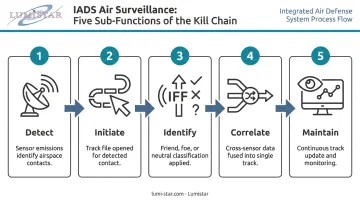
In a high-threat environment with multiple inbound aircraft, electronic countermeasures, and decoys, accurate correlation becomes a serious data processing challenge. Modern systems increasingly automate these functions, shifting operators from "man in the loop" to what JAPCC describes as "man on the loop."
Battle Management
Battle management bridges detection and action. Its four functions:
- Threat evaluation — confirming a track is a genuine threat, not a decoy or friendly aircraft
- Engagement decision — determining whether and how to respond
- Weapon selection — choosing the optimal interceptor given range, altitude, and available inventory
- Engagement authority — the final confirmation before a weapon is committed
This is where human judgment and automated decision-making intersect most directly. Speed matters — a supersonic target allows very little decision time — but an incorrect engagement authority decision can have serious consequences.
Weapons Control
With authorization granted, execution follows: the weapon pairs with the target, guides to intercept, and destroys or neutralizes it. Post-engagement, the system assesses results and updates the air picture.
How the three processes work together in sequence:
An early warning radar detects an inbound aircraft → data passes to a central command node → the threat is evaluated and a SAM battery is assigned → fire control radar locks on the target → the missile launches while other batteries remain passive to preserve their location — a discipline called emissions control.
Every active radar is a detectable signal, so effective IADS discipline means not every sensor broadcasts all the time.
IADS as a System of Systems
The S-400 is frequently cited as the world's most capable long-range SAM system. But the S-400 is not an IADS — it's a component that can function within one. Rosoboronexport lists the S-400's subcomponents as a combat control post, multiple radar types (91N6E, 92N6E, 96L6E2), and multiple launcher variants. A full S-400 set can simultaneously guide up to 160 missiles against 80 targets — a substantial capability on its own. Within a modern IADS, it's one node.
Why "Destroy One Node" No Longer Works
The traditional counter-IADS strategy — find the radar, destroy it, collapse the chain — was viable against older, centralized systems. Mitchell Institute's analysis uses a social media network as the better analogy for modern IADS: removing one user doesn't stop the network from functioning. Messages route around the gap.
Modern IADS achieve this through:
- Redundant communications across multiple pathways
- "Skip echelon" capability — the ability to bypass a destroyed intermediate node and communicate directly between remaining nodes
- Distributed command arrangements where individual batteries can operate autonomously if the central node is lost
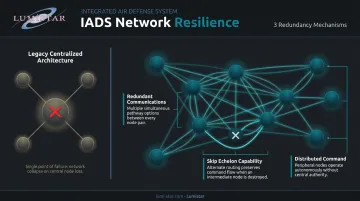
Effective counter-IADS operations must therefore simultaneously disrupt, degrade, and delay across multiple nodes — not just destroy the most visible radar. Targeting one element in isolation leaves the rest of the network functional.
IADS and the A2/AD Strategic Challenge
Advanced IADS form the backbone of anti-access/area denial (A2/AD) strategies. Deny an adversary's air force freedom of movement at strategic distances, and you protect your own centers of gravity while forcing that adversary into less favorable engagement conditions.
Russia deployed S-400 units to Kaliningrad in 2016 and Crimea in 2017, specifically to extend defensive coverage over key military positions. China's IADS, according to a RUSI analysis, is less centrally integrated than Russia's but more distributed and mobile, incorporating HQ-9 and SA-21 long-range systems.
Countering an IADS: SEAD and DEAD
Air forces use two primary mission types to address IADS threats:
- SEAD (Suppression of Enemy Air Defenses) — degrade or disrupt IADS effectiveness without necessarily destroying components; anti-radiation missiles, electronic jamming, and cyber operations fall here
- DEAD (Destruction of Enemy Air Defenses) — physically eliminate IADS components; stand-off cruise missiles, direct-attack weapons, and stealth aircraft penetration fall here
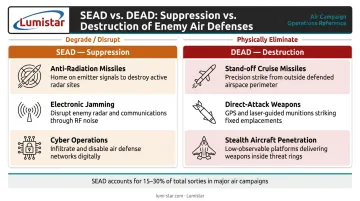
SEAD historically accounts for 15–30% of total sorties in major air campaigns. In the first 72 hours of the 1991 Gulf War, coalition forces neutralized Iraqi IADS with minimal resistance. The 2022 Ukraine invasion showed the opposite dynamic: Russia struck more than 100 Ukrainian air defense targets in its opening 72 hours, yet a resilient, distributed Ukrainian IADS survived and contested airspace throughout the conflict.
As Col. John Warden wrote in The Air Campaign: "Air superiority is prerequisite for victory or even survival." A dense, well-integrated IADS can deny that superiority — which is precisely why countering IADS sits at the top of air campaign planning.
Testing and Validating IADS-Related Systems
Before any IADS component reaches operational deployment, it must be validated under realistic conditions. The DOT&E FY2024 report states that evaluating integrated air defense systems requires a joint modeling and simulation environment capable of end-to-end performance assessment — including live aircraft and ground systems operating together.
Major U.S. test ranges support this work. Eglin Air Force Base's 96th Test Wing covers 724 square miles of land range across 70 test and training areas. Point Mugu's 36,000-square-mile sea range supports developmental and operational test of missiles and weapons systems. White Sands Missile Range conducts air and missile defense testing against multiple aerial threat types.

The Role of Flight Test Telemetry
Every test event — whether a missile intercept, a radar performance trial, or a command system integration test — generates data that must be captured, transmitted, and analyzed with precision. Flight test telemetry infrastructure is central to capturing that data reliably.
Live-virtual-constructive (LVC) environments allow test organizations to simulate IADS at scale. They combine real hardware, simulated platforms, and constructive elements to create scenarios that would be impractical or cost-prohibitive to run live. As IADS test scenarios grow more complex, the need for precise, reliable telemetry data capture — in both live and simulated environments — becomes a harder requirement to meet, not a softer one.
Frequently Asked Questions
What does IADS stand for in the military?
IADS stands for Integrated Air Defense System. Per JP 3-01, it describes the networked aggregate of radars, surface-to-air missiles, command-and-control systems, communications, and electronic warfare assets organized to detect and defeat airborne threats across a defended territory — not a single platform or weapon in isolation.
How do IADS work?
IADS work by linking sensors (which detect and track threats), command-and-control nodes (which evaluate threats and assign weapons), and SAM batteries (which execute engagements) into a coordinated network. The system responds as a unified whole rather than a collection of independent components, which makes it considerably more capable than isolated batteries operating without shared data.
What is the difference between an air defense system and an IADS?
A standalone air defense system — such as a single SAM battery — operates independently with its own organic sensors. An IADS integrates multiple such systems into a networked architecture with shared data, centralized command, and coordinated engagement, making it substantially more capable and resilient than any individual component.
What is an IAD weapon?
An IAD weapon refers to any weapon operating within an Integrated Air Defense network: most commonly surface-to-air missiles like Russia's S-400 or China's HQ-9, but also fighter aircraft, electronic warfare platforms, and anti-aircraft artillery functioning as part of the broader system.
How do militaries counter or defeat an IADS?
Air forces use SEAD and DEAD, employing anti-radiation missiles, stealth aircraft, electronic jamming, stand-off weapons, and cyber operations. The objective is disrupting network integration across multiple nodes simultaneously, not destroying individual launchers one at a time.
How much does an IADS cost?
Costs vary widely. Reuters reported Turkey's four S-400 batteries at roughly $2.5 billion and India's five-system deal at approximately $5.5 billion. A full national-level IADS covering multiple SAM layers, command infrastructure, and sustainment represents a multi-billion-dollar commitment that few nations can sustain independently.