As UAVs operate in increasingly contested environments, securing the telemetry pipeline has moved from a technical consideration to a mission-critical requirement. A GAO review of DoD weapon systems tested between 2012 and 2017 found mission-critical cyber vulnerabilities in nearly all systems under development — with testers gaining initial access within an hour using basic tools. UAV telemetry links are not exempt from that exposure.
This article covers the specific threats that put telemetry data at risk, the technical defenses that address them, and the standards and design principles that govern data integrity in professional aeronautical flight test environments.
Key Takeaways
- Secure telemetry protects UAV data from interception, tampering, corruption, and replay attacks — from sensor to ground station
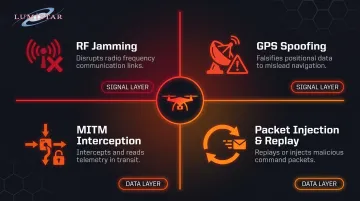
- Primary threat vectors: RF jamming, GPS spoofing, man-in-the-middle interception, and packet injection at the data layer
- Core defenses: AES-based or lightweight encryption, CRC validation, and mutual authentication
- IRIG 106 provides the standardized framework for telemetry data integrity in aeronautical and defense flight test
- FPGA-based hardware encryption removes the latency penalty — security and real-time performance are no longer in conflict
Why Secure Telemetry Is Mission-Critical in UAV Flight Test Operations
What UAV Telemetry Actually Carries
A UAV telemetry link carries far more than GPS coordinates. The full data stream typically includes:
- Flight state parameters — position, altitude, velocity, attitude
- Propulsion and structural health data — engine performance, vibration, load
- Payload sensor feeds — EO/IR imagery metadata, radar returns, signals intelligence
- Guidance and control commands — uplink commands that directly affect vehicle behavior
- Safety-of-flight indicators — fault flags, fuel state, control surface health
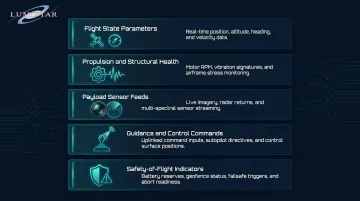
Each data type carries a different integrity requirement. A corrupted structural health packet may be recoverable in post-processing. A manipulated control command is not.
The Asymmetry of Consequence
In commercial drone applications, a corrupted packet often produces a minor anomaly — a missed waypoint, a stale sensor reading. In defense flight test or range operations, the same failure mode can result in loss of vehicle, mission failure, or a range safety incident.
The stakes are compounded by the evidentiary role of telemetry data in flight test. Engineers rely on it for post-flight analysis, airworthiness validation, and program-level decisions. When data integrity is compromised, test results cannot be certified. Federal test ranges and defense programs operate under explicit data fidelity requirements — operators must be able to demonstrate the authenticity and completeness of every telemetry record. Meeting those requirements is a contractual and regulatory obligation, not a best practice.
The Threat Landscape: What Can Go Wrong
Signal-Layer Threats
RF Jamming overwhelms the telemetry frequency with interference, causing link dropout and data loss. Broadband denial-of-service jamming is disruptive but relatively easy to detect. Narrowband jamming — targeted at a specific telemetry frequency — is more dangerous because it can selectively degrade a link while leaving adjacent systems unaffected, making it harder to diagnose in real time.
GPS spoofing is no longer theoretical. In 2012, University of Texas researchers successfully demonstrated GPS spoofing against a UAV at White Sands at the invitation of DHS — redirecting the vehicle's flight path without triggering any onboard alert. Since then, GPS spoofing has become a documented tactical tool in active conflicts, with reported use against UAVs in the Russia-Ukraine theater.
For beyond visual line of sight (BVLOS) operations, where the crew cannot visually verify vehicle position, false navigation data fed into the telemetry stream can corrupt the mission record — and cause severe consequences — before anyone detects the anomaly.
Data-Layer Threats
Man-in-the-middle (MITM) interception occurs when an unauthorized receiver passively collects raw telemetry. On an unencrypted link, researchers have demonstrated the ability to read and alter data streams between UAV and ground station in real time — a finding documented in UAV cybersecurity reviews by both NASA and academic institutions.
Sensitive flight test parameters, proprietary system performance data, and mission telemetry are all exposed on an unprotected link.
Packet injection and replay attacks extend the threat beyond passive eavesdropping. An adversary who has observed a telemetry protocol can inject malicious command packets or replay previously captured authentic commands to manipulate vehicle behavior and corrupt the data record. MAVLink 2's authentication architecture specifically addresses this — it uses a 48-bit monotonically increasing timestamp so any replayed message with an older timestamp is automatically discarded.
Bit errors and packet corruption come from two distinct sources: adversarial manipulation and natural causes (multipath interference, atmospheric conditions, hardware noise). Both require the same detection mechanisms. Whether the corruption is intentional or environmental, undetected errors in the telemetry record undermine the validity of every data point that follows.
Technical Approaches to Securing UAV Telemetry Data
Encryption and Authentication
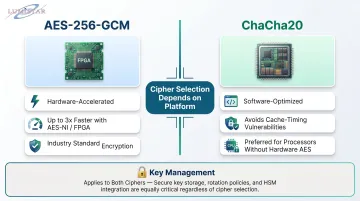
AES-128 and AES-256 are the current standard for securing telemetry payloads. AES-256 is specifically recommended by CISA for sensitive UAS data transmissions. The algorithm prevents passive interception, but the encryption is only as strong as the key management around it. In flight test environments, secure key distribution and key rotation discipline matter as much as the cipher selection itself.
For resource-constrained onboard hardware where dedicated AES acceleration isn't available, ChaCha20 (defined in IETF RFC 8439) offers a 256-bit key stream cipher that avoids cache-timing side-channel vulnerabilities — a meaningful advantage on embedded processors. The practical choice depends on your platform:
- AES-256-GCM: Up to 3x faster on hardware with AES-NI or FPGA acceleration
- ChaCha20: Stronger practical choice on processors without hardware AES support
- Key management: Regardless of cipher, secure key distribution and rotation discipline are non-negotiable at the system level
Mutual authentication ensures that both the UAV transmitter and the ground station receiver verify each other's identity before accepting data. This prevents spoofed transmitters or rogue ground stations from injecting false data into the system.
MAVLink 2's signing mechanism offers a working reference: it appends a 13-byte block per packet containing a link ID, timestamp, and a 48-bit SHA-256 hash derived from a shared 256-bit secret key — lightweight enough for bandwidth-constrained links and rigorous enough to catch injection attempts.
Error Detection and Data Validation
Authentication controls who can send data. Error detection controls whether the data that arrives is intact. Both layers are required for a trustworthy telemetry record.
CRC (Cyclic Redundancy Check) is the workhorse of telemetry data integrity at the packet level. CRC-16 and CRC-32 both detect transmission errors; CRC-32's undetected error probability is mathematically bounded at 2⁻³², roughly 1 in 4.3 billion frames. For professional telemetry protocols, CRC validation is standard practice. Simpler XOR checksums suit only low-risk, severely resource-constrained applications.
Lumistar's LS-50-E PCIe decommutator implements CRC-16/CCITT checking as a standard feature, integrated directly into the decommutation process so validation occurs inline with reception — not as a separate post-processing step.
Sequence numbering and timestamp validation defend against replay attacks and packet reordering. Requiring monotonically increasing sequence numbers and validating timestamps against expected windows allows ground station software to detect and discard duplicated or out-of-order packets before they corrupt the data record.
IRIG 106 Compliance and Standardized Data Integrity
IRIG 106 — maintained by the Telemetry Group of the Range Commanders Council — is the governing standard for telemetry systems used in flight test and range operations. The current release is IRIG 106-2022. It defines everything from RF link parameters and frequency band allocations (L-band, S-band, and C-band) to PCM formatting, frame synchronization patterns, and bit error rate thresholds.
For data integrity specifically, IRIG 106 contributes through:
- Defined frame synchronization patterns that ensure ground stations lock onto telemetry streams with verifiable fidelity
- PCM (Pulse Code Modulation) formatting requirements (Chapter 4) that establish Class I and Class II standards for data structure and quality
- CRC provisions for Class II frames, making error detection part of the data format specification
- BER targets (typically 10⁻⁵ or better) that define what constitutes an acceptable link for certified test data
IRIG 106 is primarily an interoperability and data quality standard — it governs the fidelity of the link and the format of the record, not encryption. Cybersecurity requirements are addressed through separate frameworks, notably RTCA DO-326A for airworthiness security. Defense programs need to treat IRIG 106 compliance, DO-326A, and CISA encryption guidance as a unified requirement set. Treating them as independent checkboxes leaves exploitable gaps at every interface.
Meeting that unified requirement set starts at the hardware layer. Lumistar's telemetry receiving and retransmission systems (including the LS-28-DRSM series, LS-50 series decommutators, and LS-18 series simulators) are purpose-built for IRIG 106 Class I and II compliance.
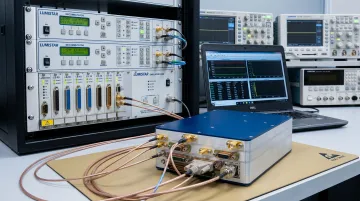
The LS-28-DRSM supports all six IRIG 106 LDPC forward error correction codes and IRIG 200 time code formats A, B, and G for precise timing synchronization. Time-stamped data records satisfy post-flight auditability requirements, while integrated BER readers deliver quantifiable link quality metrics directly at the hardware level.
Balancing Security with Real-Time Proven Performance
The central tension in telemetry security is computational: encryption, authentication, and validation all add processing overhead. Safety-of-flight decisions may depend on telemetry arriving within tight latency windows, and every microsecond of added latency must be justified by the security it provides.
Hardware acceleration resolves this directly, and the performance gap is not close.
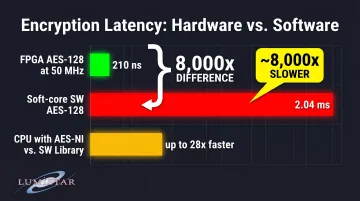
A 2025 study from Linköping University found that an FPGA-based AES-128 implementation encrypted a 16-byte block in 210 nanoseconds. The software equivalent on a soft-core processor required 2.04 milliseconds — roughly 8,000 times slower. At flight test data rates, software encryption alone is not viable. FPGA-based crypto acceleration eliminates encryption as a latency bottleneck entirely.
| Implementation | Encryption Time (16-byte block) | Relative Speed |
|---|---|---|
| FPGA AES-128 (50 MHz) | 210 ns | Baseline |
| Soft-core SW AES-128 | 2.04 ms | ~8,000x slower |
| CPU with AES-NI vs. SW library | — | Up to 28x faster |
Lumistar's LS-28-DRSM series uses FPGA-based processing architecture and supports encryption/decryption operations at data rates up to 60 Mbps — handling the cryptographic workload in hardware without burdening the main processor or introducing throughput degradation.
Hardware speed alone doesn't solve the full problem. Threats evolve, encryption standards update, and defense flight test programs run for years. Telemetry systems that require hardware replacement every time security parameters change create both operational risk and cost exposure.
Field configurability is the other half of the equation. Lumistar's firmware-based, OS-less architecture lets programs update security parameters without swapping hardware. The LS-28-DRSM supports field firmware updates for new modulation formats and DSP algorithm improvements via:
- Ethernet
- USB
- RS-232
The LS-18 series supports firmware license file upgrades through the same process. When a program needs to adopt updated encryption protocols, the change deploys to the fielded system — no hardware pull, no depot return.
Frequently Asked Questions
What is data integrity in the context of UAV telemetry?
Data integrity means the telemetry received at the ground station is identical to what the UAV transmitted : unaltered, complete, and from a verified source. It is confirmed through CRC checks at the packet level, cryptographic authentication of the data source, and timestamp validation that detects replayed or reordered packets.
What are the most common threats to UAV telemetry security?
Four categories cover most of the threat surface: RF jamming (signal denial through interference), GPS and signal spoofing (injection of false navigation or sensor data), passive MITM interception (eavesdropping on unencrypted links), and packet injection or replay attacks at the data layer that manipulate vehicle behavior or corrupt records.
How does encryption affect real-time telemetry performance?
With hardware acceleration (FPGA implementations or AES-NI capable processors), encryption adds negligible latency. The key is matching algorithm selection to platform constraints: on embedded processors without hardware AES support, ChaCha20 delivers comparable performance while avoiding software AES cache-timing vulnerabilities.
What is IRIG 106 and why does it matter for telemetry data integrity?
IRIG 106 is the U.S. range telemetry standard governing data formats, frame synchronization, PCM requirements, and RF link parameters. Compliance ensures that telemetry is collected and recorded in a verified, auditable format , making the data defensible for flight test certification and post-flight analysis at federal test ranges.
What is the difference between spoofing and jamming in UAV telemetry?
Jamming denies the link by overpowering the signal so legitimate telemetry cannot get through. Spoofing is subtler: it introduces convincingly formatted false data so the system acts on fraudulent information without detecting the intrusion. Jamming is countered through frequency agility and spread spectrum; spoofing requires cryptographic authentication of the data source.