Introduction
Push an FPV aircraft far enough and the goggles-direct video link starts to break down. Antenna gain runs out, receiver sensitivity hits its floor, and the pilot loses the feed — often at the worst possible moment. At that point, a dedicated ground station stops being optional.
Most people encounter the term without a clear sense of what the hardware actually does. A ground station can mean a $300 portable unit built for long-range wing flying or a room-sized telemetry installation processing data from a supersonic test aircraft. The underlying RF engineering principles connect them — but the gap in capability, complexity, and application is significant.
This guide covers what an FPV ground station is, what it's made of, and how it functions — from 2.4GHz consumer video receivers to aeronautical telemetry systems used in professional flight test programs.
Key Takeaways
- An FPV ground station is a ground-based hub that receives video, telemetry, or both from an aircraft in flight
- Core hardware: RF telemetry receiver, demodulator, data processor, antenna(s), and display or archiving system
- Extends range and situational awareness well beyond single-receiver or portable-only configurations
- Spans from compact portable units to full rack-mount, IRIG 106-compliant professional telemetry systems
- Choosing the right setup depends on frequency, range, and data output requirements
What Is an FPV Ground Station?
An FPV ground station is a ground-based assembly designed to receive and process the RF signal broadcast by a drone or aircraft — capturing video, telemetry data, or both. It acts as the fixed receiving point that the pilot or operations team relies on to monitor the flight.
Standard FPV goggles receive video directly from the drone, but range is constrained by antenna gain, receiver sensitivity, and frequency characteristics. A dedicated ground station solves this by placing higher-gain directional antennas, stronger receivers, and signal relay capability at a stable fixed point — decoupled from the pilot's head movement and optimized for maximum signal capture.
It is a dedicated receiving and monitoring assembly, separate from flight control. It is not an RC transmitter, a pair of goggles, or a flight controller. The ground station captures what the aircraft sees; directing the aircraft is handled elsewhere.
Core Components of an FPV Ground Station
Video Receiver (VRX)
The VRX is the central module that tunes to the frequency broadcast by the drone's video transmitter (VTX) and decodes the incoming signal. Receiver sensitivity determines how weak a signal the VRX can still usefully decode — directly setting the range ceiling.
The ImmersionRC RapidFIRE reaches -96 dBm sensitivity across 48 channels on six bands, using signal fusion rather than traditional antenna switching to eliminate the frame tearing common in older diversity setups.
Antenna System
Antenna choice is the single highest-leverage range variable in any ground station build.
| Antenna Type | Typical Gain | Best Use |
|---|---|---|
| Omnidirectional (cloverleaf, pagoda) | 1–3 dBi | Proximity flying, short range |
| Directional patch | 8–10 dBi | Medium-range fixed-wing |
| Helical (7-turn) | ~12 dBi | Long-range directional links |
| Yagi | 10–15+ dBi | Maximum range applications |
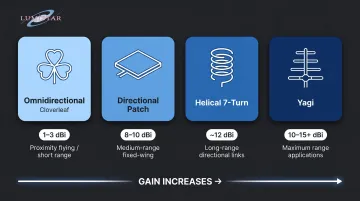
A 6 dB gain increase effectively doubles maximum flight range, making antenna selection more impactful than most other hardware upgrades.
Polarization is equally critical. Circular polarization (CP) rejects multipath interference and maintains signal regardless of drone orientation. Key mismatches to avoid:
- CP + LP mix: causes a 3 dB (50%) power loss
- 90-degree cross-polarization misalignment: causes over 20 dB loss — roughly a 90% range reduction
Display Screen and Power Supply
Many dedicated ground stations include a built-in LCD screen showing the live video feed — useful for monitoring during long-range flights and allowing ground crew to track flight status without additional equipment.
Power typically comes from a LiPo battery via XT60. Key power features on better-equipped units include:
- 12V passthrough to goggles and accessories via RJ45 or USB
- Single-battery operation for the entire field setup
Signal Relay / VTX Output
Most ground station units include a relay VTX output port. This lets the received signal — for example, 2.4 GHz from the aircraft — be rebroadcast on 5.8 GHz to the pilot's goggles. The result:
- Decouples the video link frequency from the goggle frequency
- Allows multiple operators to receive the feed simultaneously
How Does an FPV Ground Station Work?
A ground station operates through a defined signal chain — from RF capture at the antenna to decoded video on the display. Each stage affects latency, signal quality, and effective range.
RF Reception
The aircraft's VTX broadcasts a modulated RF signal on a specific frequency channel. The ground station antenna intercepts this signal; its gain, polarization match, and pointing accuracy determine how much usable signal energy reaches the receiver.
For long-range operations, signal strength falls off with distance according to the free-space path loss equation. A high-gain directional antenna like a Yagi or patch concentrates reception into a narrow beam aligned toward the aircraft. This narrow focus requires either careful manual aiming or an antenna tracker for extended flights.
Signal Processing
The VRX receives the captured RF signal and performs frequency selection, amplification, and demodulation, converting the modulated carrier back into a baseband video signal.
Diversity receiver setups improve consistency across different flight distances and directions:
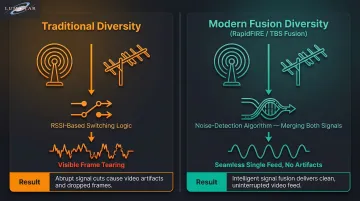
- Traditional diversity: two antennas (typically one omni + one directional), system switches to whichever has stronger RSSI, which can cause visible frame tearing
- Modern fusion diversity (RapidFIRE, TBS Fusion): merges both signals into a single output using noise-detection algorithms, eliminating switching artifacts entirely
Output and Display
Once demodulated, the video feeds into the onboard display or analog video output ports. The relay VTX (if present) retransmits the processed video on a secondary frequency band for goggle-based viewing.
In professional configurations, the output stage adds data logging, telemetry decoding, and integration with ground control software. At that level, the ground station goes well beyond video relay, functioning as a centralized hub for recording flight data and feeding it into mission planning or post-flight analysis tools.
Types of FPV Ground Stations
Consumer and Hobbyist Ground Stations
The TBS Groundstation is the clearest benchmark for portable, all-in-one consumer units. It combines:
- 2.4GHz, 16-channel video receiver
- Built-in 4-inch LCD screen
- Relay 5.8GHz VTX for goggle output
- XT60 power input with 12V goggle passthrough
- Two RJ45 ports for audio/video/power distribution
Real-world range testing achieved 4.5 km with circular polarized antennas and 7.5 km with a directional 2.4GHz Yagi. These figures represent what a well-configured consumer ground station actually delivers in the field — not theoretical maximums.
DIY and Custom Builds
For pilots who want more control over their setup, custom builds are a practical alternative to off-the-shelf units. A typical DIY ground station draws from:
- Standalone VRX module
- Antenna and mounting hardware
- External monitor or display
- Power distribution board
This approach offers flexibility in frequency support and component selection, though integrating the parts requires more technical effort than a prebuilt unit.
Professional Telemetry Ground Stations
At the professional end, ground stations must do far more than display video. They receive, demodulate, and decode multi-channel telemetry data streams from aircraft under test — operating across L-band (1435–1535 MHz), S-band (2200–2395 MHz), and C-band (4400–6700 MHz) as defined by IRIG 106 Chapter 2.
Lumistar, Inc., a San Marcos, California manufacturer focused exclusively on aeronautical telemetry flight test, supplies modular ground station systems engineered for this environment. The contrast with legacy installations is stark:
| Parameter | Legacy Ground Station | Lumistar Modular (LS-28-DRSM) |
|---|---|---|
| Height | 8 feet tall | 6.00″ × 4.00″ × 1.67″ |
| Weight | 250 kg | Under 1 kg |
| Power consumption | Several thousand watts | ~40–50 watts |
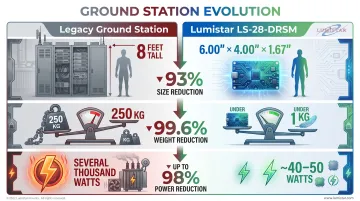
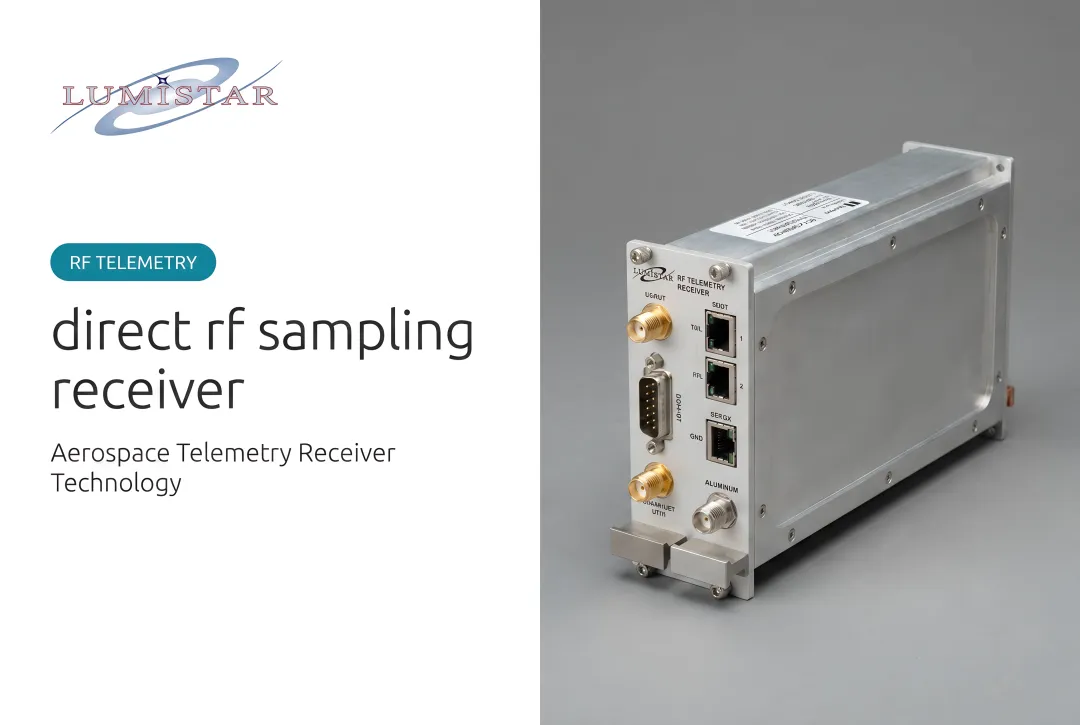
The LS-28-DRSM operates from 200 MHz to 7 GHz across dual channels, uses a firmware-based architecture with no operating system, and supports all standard demodulation formats including SOQPSK, BPSK, QPSK, PCM/FM, and Multi-H CPM at data rates up to 60 Mbps.
Firmware updates add new capabilities without hardware replacement, reducing lifecycle costs and avoiding the obsolescence problems that plague fixed-function legacy systems.
Lumistar's portable "lunchbox" version (LS-28-DRSM-P1) packages this functionality into an IP-67 rated case weighing approximately 15 pounds, with up to 10 hours of battery life. It brings the same professional-grade telemetry capability to field deployments where rack-mount infrastructure isn't available.
Where FPV Ground Stations Are Used
Long-Range FPV Flying
Ground stations are most commonly deployed in long-range fixed-wing FPV operations where the aircraft travels several kilometers from the pilot. The directional antenna advantage is decisive here: 2.4GHz is preferred over 5.8GHz for long-range video links due to lower free-space path loss at the lower frequency.
With the right configuration, documented ranges of 4.5–7.5 km are achievable; community reports push further, though verified figures are harder to come by at extreme distances.
Organized Events and Multi-Pilot Operations
At FPV races and organized flying events, a designated ground station lets race directors, safety officers, and spectators follow the feed without needing their own goggles. The relay VTX capability lets a single ground station broadcast to multiple goggle users simultaneously — useful for training sessions and public demonstrations.
Professional Aeronautical and Defense Applications
At the professional level, ground stations serve as the primary data acquisition infrastructure during aircraft flight test campaigns, missile range operations, and UAV test programs. The received data goes well beyond video. Structured telemetry streams cover:
- Flight parameters and navigation data
- Sensor outputs from onboard instrumentation
- System health and subsystem status
All of it is processed in real time and archived for post-flight analysis.
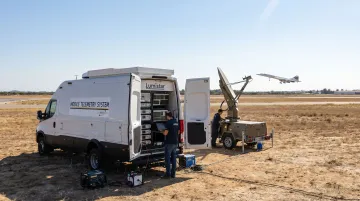
Lumistar's systems have been deployed at programs including the Kansas Supersonic Transportation Corridor (SSTC) — a 770-nautical-mile flight test route supporting Boeing, Lockheed Martin, and Boom Aerospace in supersonic aircraft testing. Lumistar designed and installed the ground systems to capture RF telemetry from supersonic platforms and deliver it to flight test engineers in real time.
That same infrastructure demand is growing in commercial operations. BVLOS waiver approvals have expanded steadily, and the FAA forecasts the US commercial drone fleet will exceed 1.118 million units by 2025. At that scale, consumer hardware can't meet the compliance and reliability requirements that purpose-built telemetry systems are designed to deliver.
Frequently Asked Questions
What is an FPV ground station?
An FPV ground station is a ground-based receiving system that captures and displays the video feed from a drone or aircraft in flight. It typically combines a video receiver, antenna, and screen into a standalone assembly separate from the pilot's goggles and RC controller.
What is the receiver on an FPV drone?
The receiver on an FPV drone is the RC receiver that accepts control signals from the pilot's radio transmitter, which is distinct from the video transmitter (VTX) that sends the video feed down to the ground station. These are two separate RF systems operating independently.
How far can a long-range FPV drone fly?
Range depends on the RC link system, video link frequency, antenna configuration, and battery capacity. With a dedicated ground station and directional antennas on a 2.4GHz video link, documented ranges of 4.5–7.5 km are achievable. Legal visual line-of-sight requirements apply in most jurisdictions regardless of technical capability.
Is long-range FPV legal?
In most countries, including the US, drone operations must remain within visual line of sight (VLOS) under 14 CFR 107.31. BVLOS operations require a Part 107 waiver from the FAA. Regulations vary internationally; check with your national aviation authority before attempting extended-range flights.
What frequency does an FPV ground station use?
Consumer hobbyist ground stations primarily use 5.8GHz (shorter range, most common) or 2.4GHz (better range, but conflicts with many RC control links). Professional aeronautical telemetry ground stations operate across dedicated L-band, S-band, and C-band allocations defined by IRIG 106 standards.
What is the difference between a hobby FPV ground station and a professional telemetry ground station?
Hobby ground stations receive analog or digital video for pilot situational awareness. Professional telemetry ground stations receive and decode structured multi-channel data streams from aircraft under test, comply with IRIG 106 standards, and integrate with data analysis and archiving systems. The two systems operate at entirely different scales of complexity and mission criticality.