Introduction
Most pilots can dial in a squawk code without thinking twice. Far fewer understand what actually happens at the signal level when they rotate the knob to "ALT" — or why the mode they select determines how completely ATC and collision avoidance systems can see them.
A transponder is an airborne transmitter-responder. It listens for interrogation signals from secondary surveillance radar (SSR) on 1030 MHz and replies on 1090 MHz. That reply is only as useful as what's inside it, and the mode governs exactly that.
Mode A, Mode C, and Mode S each define what an aircraft actually transmits in response to an interrogation — ranging from a bare identity code to GPS-derived position data inside a fully addressed message. For flight test engineers, the distinction carries extra weight: transponder output often feeds directly into the test dataset, where resolution and accuracy matter in ways that operational ATC tolerances don't fully capture.
This article breaks down each transponder mode — both civilian and military — covering what each transmits, when it's required, and where common misconceptions create real operational problems.
Key Takeaways
- Transponders reply to 1030 MHz SSR interrogations on 1090 MHz; the "mode" defines what that reply contains
- Mode A transmits only a four-digit octal squawk code (4,096 combinations); no altitude
- Mode C adds encoded pressure altitude in 100-foot increments using Gillham code
- Mode S adds a unique 24-bit ICAO address, selective interrogation, and extended flight data; it forms the foundation for ADS-B Out
- Military modes (1 through 5) layer on mission identification, encrypted authentication, and tactical data link capability
- 14 CFR § 91.215 defines minimum transponder requirements by airspace class and altitude
The Three Civilian Transponder Modes: A, C, and S
The Signal Architecture Behind All Three
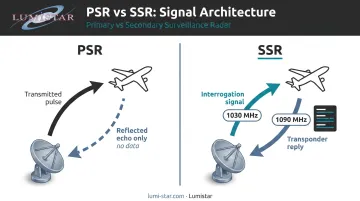
All civilian transponder modes share the same physical channel: SSR ground stations interrogate on 1030 MHz, and aircraft transponders reply on 1090 MHz. This is fundamentally different from primary surveillance radar (PSR), which bounces a transmitted pulse off the aircraft skin. PSR returns carry no data — just a position return. SSR replies carry structured data whose format and content are defined entirely by the transponder mode.
Mode A: Identity Without Altitude
Mode A sits in the ATCRBS/IFF lineage and is the most basic civilian mode. It transmits a single four-digit squawk code in response to each SSR interrogation — providing aircraft identity, nothing else.
A few details worth noting:
- Each digit is octal (0–7), which is why digits 8 and 9 don't appear on a transponder control panel
- Four octal positions yields 4,096 possible codes (8⁴), confirmed in FAA ATC guidance
- Without altitude data, ATC cannot confirm vertical separation between aircraft
Mode A alone is effectively unusable in controlled airspace today. In practice, it's always paired with Mode C — the combination is what most older transponders provide.
Mode C: Pressure Altitude in the Reply
Mode C adds encoded pressure altitude to the SSR reply using Gillham code, derived from an altitude encoder connected to the altimeter or avionics suite. Several technical points matter here:
- Altitude is reported relative to the 29.92 inHg standard datum — pressure altitude, not indicated altitude corrected for local barometric pressure
- Reporting resolution is 100-foot increments
- FAA AC 43-6D specifies that altitude reporting equipment should correspond to actual altitude within 125 feet on a 95% probability basis; ATC validates a Mode C readout if it differs by less than 300 feet from pilot-reported altitude
Flight test programs that use transponder altitude as part of their instrumentation dataset need to verify encoder accuracy against that 125-foot specification — the 300-foot ATC tolerance is operationally acceptable but too coarse for instrumentation use.
On the cockpit panel: selecting ALT engages Mode C altitude reporting, while ON powers the transponder but disables altitude output — a distinction documented in Garmin transponder pilot guides.
Mode S: Selective Addressing and Extended Data
Mode S ("Mode Select") represents a different architecture, not just an incremental improvement. Developed at MIT Lincoln Laboratory from 1969 to 1979, it moves away from the broadcast interrogation model that Mode A/C relies on.
Its core innovation is a unique 24-bit ICAO address assigned to each aircraft — a digital fingerprint that allows the SSR to interrogate specific aircraft selectively. This directly addresses garble and channel saturation in high-density airspace.
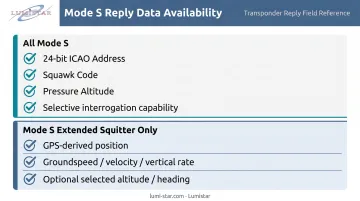
What a Mode S reply can contain:
| Data field | Availability |
|---|---|
| 24-bit ICAO address | All Mode S |
| Squawk code | All Mode S |
| Pressure altitude | All Mode S |
| GPS-derived position | Mode S Extended Squitter (ES) only |
| Groundspeed / velocity / vertical rate | Mode S ES only |
| Selected altitude / selected heading | Optional; not guaranteed on all ES units |
A common point of confusion: Mode S and ADS-B are not the same thing. A Mode S Extended Squitter transponder that also receives GPS position data broadcasts ADS-B Out on 1090 MHz. ADS-B In — receiving weather and traffic via FIS-B/TIS-B — is a separate function, not provided by the transponder itself.
Military Transponder Modes: Mode 1 Through Mode 5
Civilian aircraft use Modes A, C, and S. Military aircraft layer additional IFF (Identification Friend or Foe) modes on top, governed by STANAG standards and controlled by military authorities rather than ATC. These modes operate on the same 1030/1090 MHz channel architecture.
Mode 1 and Mode 2: Mission and Unit Identity
- Mode 1 transmits a pilot-selectable 5-bit mission code (air defense, training, intercept, etc.) assigned by military commanders per sortie
- Mode 2 transmits a four-digit unit or aircraft identifier — often ground-set for fighters, functionally equivalent to a tail number
- Neither mode is visible to civilian ATC radar systems
Mode 3/A: The Common Thread
Mode 3/A is where military and civil aviation meet. The military designation "Mode 3" and the civilian "Mode A" are operationally identical — both transmit the same four-digit octal squawk code format and are fully interoperable. This is how military aircraft operating in civil airspace communicate with standard ATC radar.
Mode 4 and Mode 5: Encrypted Authentication
Mode 4 is a cryptographically authenticated IFF mode. An authorized ground interrogator challenges the aircraft; the aircraft responds with the correct cryptographic reply or nothing. The challenge-response architecture is confirmed in public DoD documentation; cryptographic key details are classified.
Mode 5 corrects Mode 4's vulnerabilities by adding NSA-certified encryption to both interrogations and replies. According to DOT&E program documentation, it also integrates with Link 16, enabling tactical data link connectivity alongside IFF authentication — a capability Mode 4 lacked entirely.
For ground-based flight test telemetry infrastructure at military ranges, Mode 4 and Mode 5 RF environments are a range coordination consideration. Lumistar's IRIG 106-compliant receiving and processing systems operate at federal test ranges in separate frequency bands, but understanding the broader IFF environment informs range deconfliction planning.
Transponder Codes, Squawk Assignments, and the Ident Function
Mode vs. Code: A Critical Distinction
"Mode" and "code" are not interchangeable. The mode defines the type and format of information transmitted. The code (squawk) is a specific four-digit octal number the pilot enters as directed by ATC.
Standard code assignments:
- 1200 — U.S. VFR default when not otherwise assigned
- 7000 — European VFR conspicuity code (verify national AIP for country-specific requirements)
- 7500 — Hijacking / unlawful interference
- 7600 — Radio failure
- 7700 — General emergency
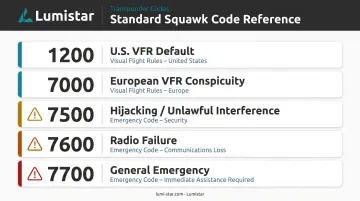
Pilots are trained to avoid dialing through "75xx" codes unnecessarily when changing squawks — momentary display of 7500 on an ATC scope triggers immediate controller response.
The Ident Function
Pressing Ident activates a Special Position Identification (SPI) feature in the transponder reply, causing the aircraft's radar return to blossom or flash on ATC displays. Controllers use it to:
- Confirm positive radar identification during initial contact
- Verify identification after controller handoffs
- Re-acquire radar contact after a brief loss
Ident is not a separate mode — it's a feature built into all Mode A, C, and S transponders. Activate it only when ATC explicitly requests it; unsolicited use can cause confusion on the controller's scope.
Current Transponder Operating Procedure
The old "standby on the ground" practice no longer reflects FAA AIM guidance. Pilots should operate transponders with altitude reporting enabled on all airport movement areas and while airborne, unless ATC directs otherwise.
Advanced avionics suites can automate this using weight-on-wheels sensing, but the baseline expectation is continuous operation from taxiway to taxiway.
How Transponder Modes Are Specified and Regulated
FAA Airspace Requirements
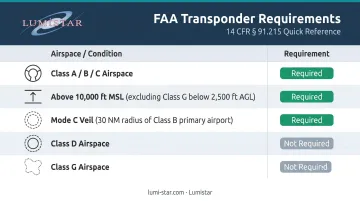
14 CFR § 91.215 defines the minimum transponder requirements:
| Airspace / Condition | Requirement |
|---|---|
| Class A, B, C airspace | Mode C (or Mode S) transponder required |
| Above 10,000 ft MSL | Mode C required, except at or below 2,500 ft AGL |
| Mode C veil (30 NM radius of Class B primary airports) | Mode C required, surface to 10,000 ft MSL |
| Class D | Two-way radio required; no transponder mandate |
| Class G | No transponder requirement |
ADS-B Out and the Mode S Connection
14 CFR § 91.225 defines ADS-B Out mandated airspace. In Class A airspace, the required equipment is 1090 MHz Extended Squitter — meaning a Mode S ES transponder. Below 18,000 feet, compliant 1090ES or 978 MHz UAT may satisfy the requirement depending on specific airspace. ADS-B Out doesn't replace the transponder; it depends on it.
Airworthiness Validation
Under 14 CFR § 91.413, transponders used in controlled airspace must be tested and inspected by an FAA-authorized repair station within the preceding 24 calendar months. Testing per Part 43 Appendix F covers:
- Reply frequency accuracy
- Reply delay and jitter
- Side Lobe Suppression (SLS) performance
- Altitude encoding correspondence (within 125 ft on a 95% probability basis per AC 43-6D)
For flight test programs that record transponder data as part of the instrumentation dataset, this certified accuracy baseline is a regulatory minimum, not a precision guarantee under all operating conditions. Ground telemetry systems receiving 1090 MHz SSR replies need signal acquisition specifications matched to what the test program actually requires.
These domestic requirements cover US operations, but the technical standards extend further. ICAO Annex 10 Volume IV governs international transponder specifications — squawk assignments and airspace class requirements vary by country, but the underlying Mode A/C/S technical standards are globally consistent.
Common Misinterpretations of Transponder Modes in Practice
Several persistent misconceptions about transponder modes create real operational and compliance gaps. The four most common are worth addressing directly.
Treating Mode C and Mode S as Interchangeable
Mode C and Mode S both report altitude, but the similarity stops there. Mode S provides a discrete 24-bit ICAO address that prevents garble in dense traffic environments. Mode S ES with ADS-B Out provides GPS-derived position — not altitude-encoder-derived pressure altitude. Conflating the two explains why Mode S gets mandated in certain environments even when Mode C technically satisfies the altitude-reporting requirement.
Assuming Squawk 1200 Provides Individual Surveillance
VFR aircraft squawking 1200 are visible on radar, but not individually identified. ATC sees a return without a linked flight plan or identity. In congested airspace, operating on the VFR conspicuity code without an assigned discrete squawk reduces ATC's practical ability to provide separation services.
Confusing "Transponder Off" with "Radar Invisible"
Primary surveillance radar can detect an aircraft skin return without any transponder reply. Switching the transponder off doesn't make an aircraft disappear — it removes:
- Altitude data
- Aircraft identity
- TCAS protection
- SSR surveillance coverage
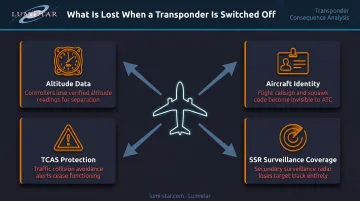
The 2006 Gol Flight 1907 / N600XL midair collision over Brazil illustrates the consequence directly. NTSB summary comments note that the Legacy 600's transponder and collision-avoidance systems were inadvertently inactivated, removing both the SSR surveillance layer and TCAS protection simultaneously.
Misreading the Mode C Veil Under ADS-B Mandates
In airspace where ADS-B Out is also required — which substantially overlaps with Mode C veil areas — a Mode S ES transponder is effectively required, not just any Mode C-capable unit. Operators with older Mode C transponders that predate the ADS-B mandate sometimes assume their equipment satisfies all current requirements within the veil — in many cases, it does not.
Frequently Asked Questions
What is a transponder used for in aviation?
A transponder responds to secondary surveillance radar interrogations, giving ATC real-time aircraft identity, altitude, and — in Mode S — position data. It also feeds TCAS, enabling collision avoidance between aircraft independent of ATC communication.
What are the different transponder modes in aviation?
Civilian modes are A (identity code only), C (identity plus pressure altitude), and S (unique ICAO address, extended data, ADS-B Out foundation). Military modes 1 and 2 carry mission and unit identity. Mode 3/A is operationally identical to civil Mode A, while Modes 4 and 5 add encrypted challenge-response authentication.
What is the difference between Mode C and Mode S transponders?
Mode C adds pressure altitude in 100-foot increments to the squawk code reply. Mode S adds a unique 24-bit ICAO address enabling selective interrogation and carries extended flight data. In Extended Squitter form, it also forms the technical foundation for ADS-B Out broadcasting.
What does squawking 7700 mean?
Squawk 7700 is the universal emergency code, recognized by ATC radar systems globally as an immediate distress signal. Controllers who see it are trained to prioritize that aircraft and coordinate emergency response services without waiting for voice communication.
Why can pilots turn off transponders?
Transponders can operate in Standby (not transmitting) in uncontrolled airspace where they aren't required. Pilots manage transponder state based on airspace class and ATC instructions. Operating in Standby or OFF in controlled airspace without authorization is a regulatory violation under 14 CFR § 91.215.
How much does an aircraft transponder cost?
Equipment-only prices range from roughly $2,445 for a Mode C unit (Garmin GTX325) to $2,387–$5,495 for Mode S with 1090ES ADS-B Out capability. These are hardware-only figures: installation labor, avionics shop certification, and FAA approval add significant cost, so verify totals with a current shop quote before budgeting.