This article builds up the answer from first principles using integer arithmetic, deliberately sidestepping Galois field theory until the intuition is solid. Once the core idea clicks, the real-world implementation details fall into place naturally.
Key Takeaways
- Reed-Solomon (RS) is a forward error correction technique that adds structured redundant symbols so a receiver can fix errors without requesting retransmission
- It works by treating the message as a polynomial, evaluating it at extra points, and using the redundant values to reconstruct corrupted data
- Correcting up to t symbol errors requires at least 2t redundant symbols
- RS codes are written RS(n, k): n total symbols, k data symbols, n−k parity symbols
- RS(255, 223) — 223 data bytes, 32 parity bytes, corrects up to 16 errors — is standard in deep-space telemetry, CDs, and QR codes
The Polynomial Foundation: Why Reed-Solomon Works
There is one mathematical fact that underpins everything in Reed-Solomon: any polynomial of degree d is uniquely defined by exactly d+1 distinct points. Give me any two points, and I can draw exactly one straight line through them. Give me three points, and there is exactly one parabola that fits. Stanford CS70 states this directly: given d+1 pairs with distinct x-values, a unique polynomial of degree at most d passes through them.
The error correction idea flows directly from this. If you evaluate a degree-3 polynomial at six x-values instead of the minimum four, those two extra values are redundant — they carry no new information about the polynomial. But they give you options.
A Concrete Example
Take f(x) = 2 + 3x − 5x² + x³, a degree-3 polynomial (degree d = 3, needs d+1 = 4 points). Evaluate it at six x-values:
| x | f(x) |
|---|---|
| −1 | 7 |
| 0 | 2 |
| 1 | 1 |
| 2 | −4 |
| 3 | −7 |
| 4 | −2 |
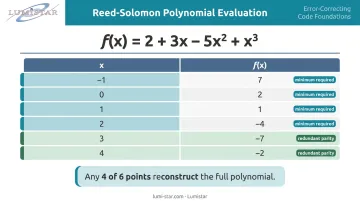
Now suppose one of those six values gets corrupted in transmission. You still have five intact values — any four of them are enough to reconstruct the original polynomial exactly. The coefficients (2, 3, −5, 1) are your message. Recovering them means recovering your data.
That reconstruction property is what makes Reed-Solomon practical — and the number of extra evaluation points you include determines exactly how much corruption the code can survive.
The Redundancy Trade-Off
More evaluation points mean more correctable errors, but also more bandwidth or storage consumed by those parity values.
The relationship is precise: 2s redundant symbols allow correction of s errors. The factor-of-two cost comes from the fact that each unknown error has two unknowns — its position and its value. Erasures (where the position is already known) cost only one symbol each to correct, which is why some implementations distinguish between the two.
Key Terminology in Reed-Solomon Coding
RS coding uses a precise vocabulary. Here's what each term means:
- Symbol — the smallest unit of data RS operates on. In real-world RS, this is typically 8 bits (one byte)
- Message word — a block of k symbols: the original data to encode
- Codeword — the encoded output of n symbols, where n > k; the message plus parity
- Alphabet — the finite set of values a symbol can take. In practical RS over GF(2⁸), this is exactly 256 values, keeping all arithmetic within 8 bits
RS(n, k) Notation
The notation RS(n, k) is shorthand for a code with:
- n total symbols in each codeword
- k data symbols (the original message)
- n−k parity symbols (redundancy)
- t = (n−k)/2 correctable symbol errors
The most widely deployed example is RS(255, 223), standardized in CCSDS 131.0-B-5 for space telemetry: 223 data bytes, 32 parity bytes, capable of correcting up to 16 symbol errors per codeword. Cassini used RS(255, 223) with interleaving depth 5, concatenated with convolutional coding, to transmit science data from over a billion kilometers away.
Reed-Solomon Encoding Step by Step
The Evaluation View
The original Reed-Solomon approach, described in Reed and Solomon's 1960 paper, is elegant: treat the k message symbols as coefficients of a polynomial, then evaluate that polynomial at n agreed-upon x-values. The n outputs form the codeword.
Worked example with k=4, n=6:
Message: (2, 3, −5, 1) Polynomial: p(x) = 2 + 3x − 5x² + x³
Evaluate at x = −1, 0, 1, 2, 3, 4:
Codeword: (7, 2, 1, −4, −7, −2)
The receiver gets these six values. If up to one is corrupted, any four intact values recover the original polynomial — and therefore the original message.
This evaluation view is clean mathematically, but it isn't how most implementations work in practice. Real systems need the original message bits to be directly recoverable without running a full decode — which leads to systematic encoding.
Systematic Encoding and the Generator Polynomial
Engineers prefer systematic codes, where the original message symbols appear unchanged at the start of the codeword with parity symbols appended. This makes decoding faster when no errors are present.
The most common real-world method is BCH-view encoding:
- Define a generator polynomial g(x) whose roots are consecutive powers of a primitive field element
- Multiply the message polynomial M(x) by x^(n−k) to shift it
- Divide by g(x) and subtract the remainder — the result is exactly divisible by g(x)
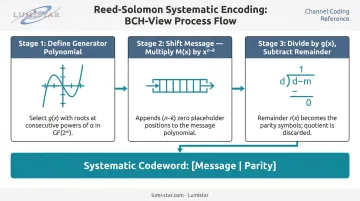
Why does divisibility matter? A valid codeword is always divisible by g(x). When the receiver evaluates the received polynomial at g(x)'s roots, the result should be zero. Any non-zero result — called a syndrome — signals that an error occurred, and each syndrome value carries information about the location and magnitude of that error.
Reed-Solomon Decoding and Error Correction
The Decoding Goal
Given a received codeword with up to t corrupted symbols at unknown positions, the decoder must:
- Determine that errors exist
- Find where they are
- Calculate how large they are
- Subtract them to restore the original codeword
Syndrome Calculation
Evaluating the received polynomial at each root of g(x) produces the syndromes. If all syndromes are zero, no errors are detected. If any are non-zero, the syndromes encode everything needed for correction — critically, they depend only on the errors themselves, not on the original message. This property makes the decoding problem tractable.
Errors vs. Erasures
There's an important distinction between two types of corruption:
| Type | Position Known? | Cost | Example |
|---|---|---|---|
| Error | No | 2 parity symbols | Random bit corruption |
| Erasure | Yes | 1 parity symbol | Demodulator flags unreliable byte |
The combined correction bound is 2e + s ≤ n−k, where e is the number of errors and s is the number of erasures. A system with 32 parity symbols (like RS(255, 223)) can correct 16 pure errors, or 32 pure erasures, or any mix in between.
The Decoding Pipeline
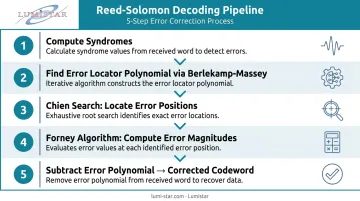
Real RS decoders follow this sequence:
- Compute syndromes — evaluate the received polynomial at g(x)'s roots
- Find the error locator polynomial — using the Berlekamp-Massey algorithm or the Euclidean algorithm
- Chien search — find the roots of the error locator polynomial to identify which symbol positions are corrupted
- Forney algorithm — compute the magnitude of each error at the located positions
- Subtract the error polynomial — correct the received codeword
Why Integer Arithmetic Doesn't Scale
The polynomial math shown here uses integers for clarity. The problem: multiplying integers produces larger integers, which demand wider registers with every operation. A practical encoder can't keep growing its register width indefinitely.
Galois field arithmetic (GF(2^m)) eliminates this constraint. In GF(2⁸), an 8-bit symbol multiplied by another 8-bit symbol always produces an 8-bit result, because the arithmetic wraps around within the field. The contrast with integer math is stark:
- Integers: each multiplication potentially doubles the result's bit-width
- GF(2⁸): every operation — addition, subtraction, multiplication — stays bounded at 8 bits
- Practical effect: register width stays fixed regardless of how many operations are chained
That bounded behavior is what makes RS codes implementable in real hardware, from FPGAs handling flight test downlinks to the demodulators that flag erasures before the decoder even runs.
Real-World Applications of Reed-Solomon Codes
Storage and Barcodes
- CDs: ECMA-130 specifies Cross-Interleaved Reed-Solomon Coding (CIRC), using two interlocked RS codes — C2 (28,24) and C1 (32,28) — to handle burst errors from scratches
- DVDs: A product code structure using RS(208,192) on columns and RS(182,172) on rows across a 208×182 byte ECC block
- QR codes: ISO/IEC 18004:2015 specifies four selectable RS error correction levels — L (~7%), M (~15%), Q (~25%), and H (~30%) of symbol codewords recoverable. Level H is why a QR code with a logo printed over it still scans.
Deep-Space and Aerospace Telemetry
Cassini's Command and Data Subsystem used RS(255, 223) with interleaving depth 5, concatenated with an inner convolutional code, to reliably downlink science data from Saturn. Voyager and Galileo used similar concatenated RS schemes with mission-specific parameters.
For flight test applications, RS-based FEC matters for a specific reason: there is no return channel. When telemetry data from a test aircraft must be recovered in real time, the ground station either corrects errors on receipt or the data is lost. IRIG 106-15 Chapter 7 accommodates optional Reed-Solomon correction, with minor frames structured as N × 223 bytes — directly matching the RS(255, 223) data block size.
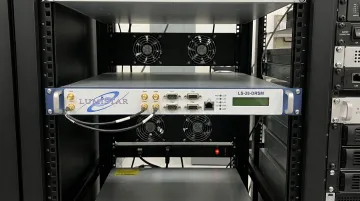
Lumistar's ground station systems support optional Reed-Solomon FEC alongside LDPC and Convolutional R1/2 encoding, compliant with IRIG 106 Chapter 4 Class I and Class II standards. Relevant platforms include:
- LS-28-DRSM Series — modular receiver/combiner with selectable FEC modes
- LS-18-R1 — rack-mount system supporting RS decoding alongside other FEC options
- LS-35-R — IF Receiver/Combiner/Modulator with optional Viterbi and Reed-Solomon decoding
Where RS Is Being Replaced
RS codes are not universal. 5G NR uses LDPC and Polar codes (per 3GPP TS 38.212); DVB-S2 satellite broadband uses BCH outer plus LDPC inner codes. These codes approach the Shannon limit more closely and operate efficiently at higher data rates.
RS remains the standard for optical storage, barcodes, and legacy/space telemetry because:
- Its symbol-error correction model matches burst-error channels well
- Its correction guarantees are deterministic and mathematically provable
- Decades of verified hardware implementations make it the trusted choice for flight-critical systems
Frequently Asked Questions
What is Reed-Solomon error correction?
Reed-Solomon is a block-based forward error correction code that adds structured redundant symbols to data, enabling a receiver to detect and correct symbol errors without requesting retransmission. It uses polynomial mathematics — originally over finite fields — to make received data self-repairing.
What is a forward error correction technique?
FEC is a class of error control methods where the sender adds redundant information before transmission, so the receiver can correct errors independently. Unlike ARQ (Automatic Repeat reQuest) schemes, FEC requires no return channel, making it essential when retransmission is impossible — as in deep-space links or real-time flight test telemetry.
How many errors can Reed-Solomon correct?
An RS(n, k) code corrects up to t = (n−k)/2 symbol errors when positions are unknown, or up to n−k erasures when positions are known. For mixed scenarios, the bound is 2e + s ≤ n−k. RS(255, 223) handles up to 16 unknown symbol errors per 255-symbol codeword.
What is Reed-Solomon code decoding?
Decoding proceeds in five steps:
- Compute syndromes from the received codeword
- Find the error locator polynomial via Berlekamp-Massey
- Locate errors using a Chien search
- Compute error magnitudes with the Forney algorithm
- Subtract the error polynomial from the received data to recover the original codeword
What is a simple example of forward error correction?
Imagine agreeing to only use words where every valid word differs from every other by at least 6 letters. A received word with a few wrong letters can be corrected by finding the nearest valid word in that reduced dictionary. RS codes implement this principle mathematically: valid codewords are spaced far enough apart that nearby corrupted versions point unambiguously back to the original.
What is the Reed-Solomon code in QR codes?
QR codes use RS error correction at four selectable levels — L, M, Q, and H — restoring approximately 7%, 15%, 25%, and 30% of codeword data respectively. Level H is why a QR code can have a company logo printed directly over part of it and still scan reliably.