Introduction
Every time a test aircraft lifts off, engineers on the ground are making decisions that directly affect whether the pilot comes home safely and whether the program stays on schedule. Aircraft telemetry is the system that makes those decisions possible in real time.
Most descriptions of telemetry focus on hardware — transmitters, receivers, demodulators. That's a reasonable starting point, but the more useful question is what flight test programs actually lose when the telemetry system can't keep up.
This article covers why aircraft telemetry matters in practice for flight test programs: the safety function it serves, the certification work it enables, and what happens when a system isn't up to the demands of the program it's supporting.
Key Takeaways
- Aircraft telemetry is the real-time wireless transmission of flight data (speed, altitude, structural loads, engine health, and more) from an airborne test article to a ground station for live monitoring and analysis.
- Its most critical function is giving ground controllers the situational awareness to intervene before an anomaly becomes a catastrophic event.
- Complete, time-synchronized telemetry data accelerates FAA and DoD certification by reducing the need for repeat test flights.
- Bandwidth-limited or poorly configured systems force engineers to drop data channels, creating blind spots in the certification record.
- Modern IRIG 106-compliant systems have shrunk from 250 kg rack installations to sub-1 kg portable units, cutting deployment cost and infrastructure overhead.
What Is Aircraft Telemetry?
Aircraft telemetry is the automated, real-time collection of data from onboard sensors and its wireless transmission via RF signals to a ground station — all while the aircraft is airborne. At the ground station, engineers monitor, record, and analyze that data as the flight unfolds.
The FAA defines Aeronautical Mobile Telemetry (AMT) as the wireless transmission and reception of data during flight tests to monitor aircraft or missile health and performance. That definition spans a wide range of parameters.
Parameters a flight test telemetry system typically covers:
- Aerodynamic performance — airspeed, altitude, angle of attack
- Structural loads — strain, vibration, acceleration
- Propulsion data — engine temperatures, fuel flow, RPM
- Control surface positions and flight control system behavior
- Environmental conditions
- System health across electrical, hydraulic, and avionics subsystems
Modern complex programs can instrument up to 200,000 data channels simultaneously. That data travels a defined chain: onboard sensors → airborne transmitter → RF link → ground station antenna → receiver → demodulator → bit synchronizer → decommutator → real-time display and recording.
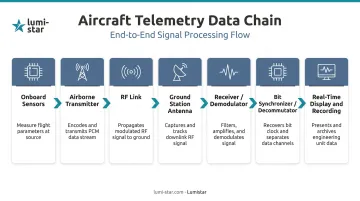
A break anywhere in that chain corrupts or loses the data record — potentially grounding a test program or masking a critical anomaly until it's too late to act on it.
Key Advantages of Aircraft Telemetry
The advantages below aren't abstract. They map directly to outcomes flight test programs track: pilot safety, test schedule, certification timeline, and program cost.
Real-Time Flight Safety Monitoring
The most fundamental advantage of aircraft telemetry is straightforward: it gives ground controllers a second-by-second view of what the aircraft is doing during the most dangerous parts of a test program.
The FAA states explicitly that AMT allows ground controllers to monitor performance second-by-second and warn pilots to abort maneuvers that could lead to structural failure. Without live data, that capability doesn't exist. Ground teams are left relying on pilot reports and post-flight downloads — a reactive posture that is inadequate for high-risk envelope expansion.
The 2009 F-22A flight test accident illustrates both the value and the limits of real-time telemetry. That aircraft transmitted telemetry to Ridley Mission Control Center throughout a weapons-integration test mission. Engineers monitored electrical, hydraulic, engine, airspeed, pressure-altitude, g-load, and angle-of-attack data in real time.
Post-accident, the IADS/telemetry record was used to reconstruct the sequence of events and evaluate flight control, fuel, and hydraulic system operation. When an aircraft is lost, real-time AMT data may be the only means to determine a crash cause.
This advantage matters most during:
- Flutter, stall, spin, and dive tests — where control surfaces and structures are pushed toward design boundaries
- High-performance and experimental vehicle testing (hypersonic, eVTOL, unmanned systems)
- Any test point where the vehicle is operating near the edge of its certified envelope
Flutter testing is a particularly demanding case. NASA's X-56A program expanded the flutter envelope in 10-knot increments — a controlled, incremental approach that depends on real-time data to confirm vehicle response at each step before proceeding to the next. The margin between controlled testing and loss of control is not measured in minutes.
Accelerated Design Validation and Certification
Aircraft certification — FAA type certification or DoD acceptance — requires exhaustive documented evidence across hundreds of test points. Telemetry is what makes that evidence complete, accurate, and retrievable.
The scale of that requirement has grown dramatically. According to FAA data, Boeing 707 flight testing in 1954 monitored 300 data channels. Boeing 777 certification in 1995 required approximately 64,000 channels. Boeing 787 certification in 2011 exceeded 200,000 channels. The FAA further notes that flight test data requirements have roughly doubled every 3–5 years.
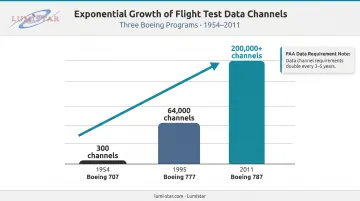
That growth creates direct certification risk. Every test point that produces incomplete or corrupted data potentially requires a repeat flight. Every repeat flight adds cost, consumes schedule, and delays certification.
What good telemetry enables at each stage:
- During flight: Engineers confirm test point completion in near-real time, identify parameters needing investigation, and begin analysis before the aircraft lands.
- Between sorties: IRIG 106 Chapter 10 time-stamped recordings enable precise correlation of data gaps with specific flight events, supporting targeted recovery efforts.
- Across the certification record: TMATS (Telemetry Attributes Transfer Standard) setup files define complex data structures and support interoperability between airborne and ground station equipment — reducing configuration overhead at the range.
Lumistar's LS-68-M series and LS-28-DRSM series support this full chain, including IRIG 106-compliant Chapter 10 recording with up to 64 GB of time-stamped storage per channel — approximately 18 hours of data at 8 Mbps per channel.
Reduced Program Cost and Test Article Risk
Test articles — prototype aircraft, advanced UAVs, experimental platforms — represent enormous investment. Losing one to an anomaly that real-time telemetry could have caught is among the most costly single events in a flight test program.
The 2009 F-22A accident, attributed to pilot-induced oscillation following an in-flight emergency, resulted in total damage estimated at $155 million. The aircraft was a low-quantity flight test asset — the kind of loss no program budget absorbs cleanly.
RAND data puts the data volume growth in context: flight test data increased from approximately 256 KB per flight for the F/A-18A/B to a projected 3–4 GB for JSF programs. Digital measurands grew from about 500 for the F-15A/B to roughly 10,000 for the F/A-18E/F.
Telemetry also reduces infrastructure cost through hardware evolution. Less than 20 years ago, a typical flight test ground station was 8 feet tall, weighed 250 kg, and consumed thousands of watts. Today, the same functionality fits in a portable unit weighing under 1 kg and drawing 50 watts or less — a reduction of more than 99% in weight. Lumistar's LS-28-DRSM-P1, for example, weighs approximately 15 pounds, operates on battery for up to 10 hours, and is housed in an IP-67 rated case that meets military transport standards.
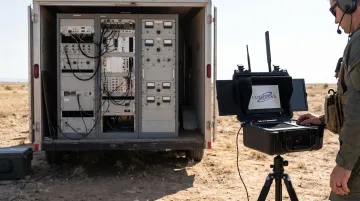
This advantage is highest-impact for:
- Programs testing high-value, limited-quantity test articles
- Programs operating at remote or austere test ranges where infrastructure is constrained
- Programs where compact, battery-operated ground stations eliminate the need for permanent facility investment
What Happens When Aircraft Telemetry Is Missing or Inadequate
When telemetry can't keep up with a program's data demands, the gaps show up fast — in schedule, cost, and certification confidence.
The FAA reports that test aircraft can collect data at gigabits per second, while AMT links typically transmit only 5–15 Mbps. That gap forces controllers to prioritize a subset of safety-critical data for transmission — the rest stays on the onboard recorder.
If the aircraft is lost, that recorder may not be recoverable. If it returns safely, processing the onboard data takes time, compressing test schedules and delaying certification.
Other consequences of inadequate telemetry:
- Ground controllers lose real-time situational awareness and shift to a reactive posture — relying on pilot reports rather than live system data
- Incomplete or corrupted data triggers repeat test flights, adding to cost and schedule pressure
- Without a complete forensic data trail, diagnosing anomalies becomes speculative — making it difficult to distinguish a design flaw from an isolated test condition
- Programs that outgrow their telemetry infrastructure face the same bandwidth constraints: as channel counts and sampling rates increase, under-specced systems create blind spots in the certification record
These tradeoffs aren't edge cases. DTIC/AIAA flutter-envelope literature documents that for certain high-sample-rate applications, real-time telemetry at the required sample rate simply wasn't practical — forcing programs to choose between coverage and bandwidth.
How to Get the Most Value from Your Aircraft Telemetry System
A telemetry system delivers its full value when the entire data chain is designed and maintained to work together reliably. Any gap in the chain — from onboard sensors through RF transmission, ground reception, demodulation, and decommutation — degrades the data record and every decision that follows.
Standards Compliance Is Non-Negotiable
IRIG 106, maintained by the Range Commanders Council (RCC) Telemetry Group, is the comprehensive standard governing interoperability for aeronautical telemetry at RCC member ranges. Compliance ensures:
- Airborne and ground station equipment from different manufacturers work together reliably
- TMATS setup files define complex data structures and transfer cleanly between systems
- Chapter 10 recording formats are standardized for certification and post-mission analysis
- TmNS (introduced in IRIG 106-19) enables bidirectional communication, dynamic spectrum sharing, and over-the-horizon relay — capabilities that go well beyond traditional one-way PCM telemetry
Meeting these requirements demands hardware that covers the full modulation and data rate envelope without forcing system redesigns as programs grow. Lumistar's LS-28-DRSM, LS-68-M, and LS-18 series address this directly — built to IRIG 106 Class I and II compliance, supporting ARTM Tier 0, 1, and 2 modulation formats and data rates up to 60 Mbps. The modular architecture lets programs scale from a single portable ground station to full range infrastructure without replacing core hardware.
Build Process Around the Data
Compliant hardware sets the foundation. What drives real value is building repeatable process around how that data is used:
- Assign qualified engineers to real-time monitoring during each flight — not just recording for post-flight review
- Review telemetry records before the next sortie — catch data quality issues before they become gaps in the certification record
- Use the complete telemetry record to drive design decisions — not just to satisfy documentation requirements
- Validate ground station configuration before each test campaign — configuration errors introduce avoidable data gaps at the worst possible time
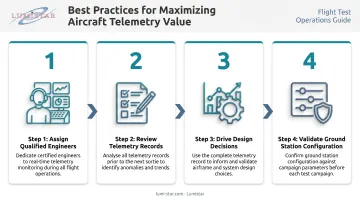
Lumistar systems support auto-boot to last saved configuration and TCP/IP network configuration file upload, which reduces setup risk and keeps sorties on schedule.
Conclusion
Aircraft telemetry isn't a background system. It's the primary mechanism by which flight test programs manage safety risk, validate designs, and build the documented evidence that certification requires.
Its advantages compound over the life of a program:
- Early anomaly detection prevents test article losses
- Complete data capture reduces the need for repeat flights
- A reliable telemetry record accelerates the path to certification
As aircraft systems grow more complex and data channel requirements continue doubling every few years, a program's telemetry infrastructure directly determines whether that program finishes on time, on budget, and with all crew members accounted for.
Frequently Asked Questions
What is aircraft telemetry?
Aircraft telemetry is the automated, real-time collection of sensor data from an aircraft and its wireless transmission via RF signals to a ground station. Engineers use it to monitor and analyze parameters — speed, altitude, structural loads, engine performance, and system health — while the flight is in progress.
Is aircraft telemetry the same as GPS?
GPS is one sensor type whose position and navigation data may be included in a telemetry stream, but it's a small piece of a much larger system. Aircraft telemetry collects and transmits data from dozens to hundreds of sensor types simultaneously. GPS tells you where the aircraft is. Telemetry captures the full picture of how it's performing.
What types of data does aircraft telemetry collect?
The main categories are aerodynamic performance, structural loads, propulsion data, control surface positions, environmental conditions, and system health. Channel counts range from a few hundred on simpler programs to over 200,000 on complex modern aircraft.
What is IRIG 106, and why does it matter for flight test telemetry?
IRIG 106 is the telemetry standard published by the Range Commanders Council that governs data formats, protocols, and equipment interoperability for flight test telemetry. Compliance ensures equipment from different manufacturers works together reliably and that data records are standardized for certification, analysis, and cross-range operations.
How does a ground station receive and process aircraft telemetry data?
The ground station antenna receives the RF signal, which is amplified, frequency-converted, and fed into a demodulator to extract the data stream. A bit synchronizer, frame synchronizer, and decommutator then process that stream sequentially — recovering the clock, segmenting the data into defined structures, and separating it into individual sensor channels for display, storage, and analysis.
What is the difference between PCM telemetry and network-based telemetry systems like TmNS?
PCM (Pulse Code Modulation) is a traditional unidirectional serial format with fixed bandwidth. TmNS (Telemetry Network Standard, incorporated into IRIG 106-19) uses Ethernet-based, bidirectional communication — supporting higher throughput, real-time retrieval of dropped data, dynamic spectrum sharing, and in-flight configuration of airborne equipment from the ground.