Introduction
Modern RF environments don't wait. Radar pulses last microseconds. Frequency-hopping emitters jump hundreds of times per second. In flight test, electronic warfare, and SIGINT programs, missing even a fraction of the spectral environment means missing data that can't be recovered.
That's why wideband RF signal recording has shifted from a niche capability to a baseline program requirement. According to USAF doctrine, congestion in the electromagnetic spectrum has increased steadily as both military and civilian emitter density grows. The DoD's Electromagnetic Spectrum Superiority Strategy frames this as a contested, constrained operating reality with no sign of easing.
This guide covers what engineers and program managers need to evaluate wideband recording systems: core technical parameters, operating modes, key application areas, and the selection criteria that drive decisions in aerospace and defense deployments.
What Is Wideband RF Signal Recording?
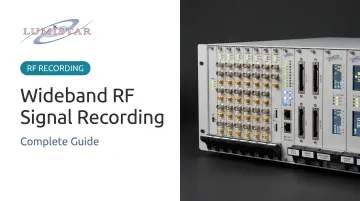
Wideband RF signal recording is the continuous digitization and storage of RF signals across a broad instantaneous bandwidth — without tuning, without gaps. High-speed analog-to-digital converters (ADCs) sample the incoming RF or IF signal, and the resulting digital samples are written to storage for post-processing, replay, or real-time analysis.
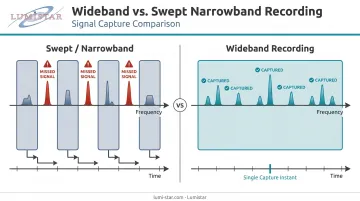
The distinction from narrowband or swept approaches matters. A swept receiver steps across frequencies sequentially, which means any signal that appears between steps simply goes undetected. Wideband recording captures everything within the acquisition window simultaneously — no stepping, no missed events.
Why this matters in defense and aerospace:
- Radar pulses are transient — often microseconds wide
- Frequency-agile emitters change channels faster than swept systems can follow
- Spread-spectrum signals occupy wide swaths of spectrum deliberately
- EW emissions may appear unpredictably across broad frequency ranges
When signals can't be predicted by time or frequency, a narrow capture window means missing exactly the data you need.
Core Technical Parameters
Understanding what separates capable systems from inadequate ones comes down to five parameters. Each one has direct consequences for what you can capture and how reliably you can analyze it afterward.
Instantaneous Bandwidth (IBW)
IBW defines the frequency span captured simultaneously without any retuning. Modern packaged RF recording solutions now reach 2 GHz instantaneous bandwidth — Keysight's ultra-wideband recording solution cites this figure for wideband radar characterization — while multichannel systems such as NI's PXI-based platform support 1 GHz IBW across up to 32 RF channels.
At the other end of the spectrum, purpose-built telemetry recorders like Lumistar's LS-29-R2 operate at 50 MHz IBW per channel, delivering 100–200 MHz system bandwidth across two or four channels. That bandwidth profile matches the L-band and S-band telemetry links that dominate aeronautical flight test.
Sample Rate and ADC Resolution
Sample rate sets the maximum capturable bandwidth through the Nyquist criterion: the sample rate must be at least twice the signal bandwidth. Current RF-sampling ADCs push well beyond traditional limits — Texas Instruments' ADC12DJ5200RF achieves 10.4 GSPS single-channel at 12 bits, while Analog Devices' ADC32RF55 delivers 3.0 GSPS at 14 bits per channel.
Bit depth (ADC resolution) determines dynamic range. More bits mean more headroom to resolve weak signals sitting beside strong ones in the same capture band.
Dynamic Range and SFDR
Spurious-Free Dynamic Range (SFDR) is the ratio of the RMS carrier amplitude to the largest spurious or harmonic distortion component. In dense RF environments — EW scenarios, SIGINT collection — strong emitters can mask weaker ones if SFDR is insufficient. The ADC32RF55 achieves 68 dBc SFDR at a 1.8 GHz input, a common benchmark for defense-grade RF digitization.
Lumistar's LS-29-R2 specifies 120 dB Instantaneous Dynamic Range, giving it the headroom to capture both high-power and low-power signals within the same acquisition window without the strong signal corrupting the weak one.
Timing Accuracy and Synchronization
GPS-referenced and IRIG-based time-stamping enables precise correlation of recorded data across time and distributed recording nodes. For direction finding, multi-channel radar analysis, and flight test telemetry, synchronization accuracy in the nanosecond range is required.
The LS-29-R2 achieves ±20 nanoseconds timing accuracy via its internal 1 PPS interface. It supports IRIG A/B/G time codes and IEEE 1588 PTP, covering both traditional range timing infrastructure and modern Ethernet-based networks.
Data Throughput and Storage
High sample rates generate large data volumes fast. A single 16-bit channel at 1 GS/s produces 2 GB/s of raw data; complex I/Q at the same rate doubles that to 4 GB/s. Sustained write speed to storage — not peak speed — determines whether recording is truly lossless.
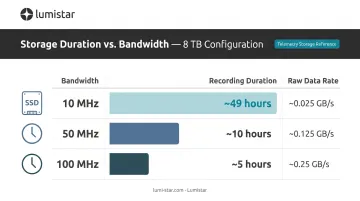
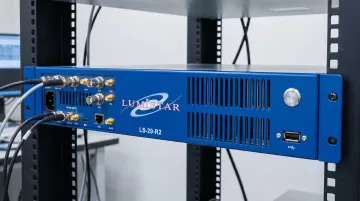
The LS-29-R2 achieves 6 GB/s sustained write to solid-state removable storage, with a standard 8 TB configuration (expandable to 16 TB). At 100 MHz bandwidth, that provides roughly 5 hours of continuous recording. Drop to 10 MHz bandwidth and that extends to nearly 50 hours. Bandwidth selection directly shapes how long a mission can run without interruption.
Wideband vs. Narrowband Recording Modes
No single recording mode fits every application. The choice depends on what signals need to be captured, how predictable they are, and how much storage budget the program can afford.
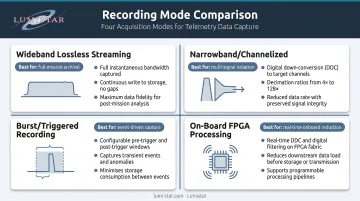
Wideband (Lossless) Streaming
All samples within the capture bandwidth are written continuously to storage; nothing is filtered or discarded. This is the right choice when the full spectral environment must be preserved and signal timing or frequency cannot be predicted in advance. Typical use cases include:
- Active radar characterization
- Flight test RF environment capture
- Wideband SIGINT collection
It demands the highest sustained write performance from the storage subsystem.
Narrowband and Channelized Streaming
The recorder acquires the full wideband signal but applies digital downconversion (DDC) to extract only the sub-bands of interest before writing to storage. DDC stages can provide 4x to 128x decimation (as in TI's ADC32RF55 architecture), cutting data rates by 4x to 128x while preserving signal fidelity on the channels that matter. This approach fits well for GNSS validation, multi-channel telemetry monitoring, and scenarios where the signals of interest are predictable by frequency.
Burst and Triggered Recording
Recording activates only when a trigger condition is met — a hardware pulse, a software amplitude threshold, or a signal detection event — and captures a defined window around that trigger (pre- and post-trigger). Useful in pulsed radar environments and unattended spectrum monitoring where events of interest are sparse and storage conservation matters. The LS-29-R2 supports software-triggered recording modes for this purpose.
On-Board FPGA Processing
FPGAs embedded in the recorder perform DDC, decimation, filtering, and custom signal processing algorithms directly on the digitized samples before data reaches storage. This reduces downstream data rates without requiring separate post-processing hardware. Lumistar's LS-35-R IF Receiver uses dual Xilinx Virtex-5 FPGAs for real-time digital processing, and the LS-28-DRSM series incorporates up to 40,000 FIR filter configurations for fine-grained IF bandwidth selection. Selecting the right mode — or combining modes — determines both the fidelity of the recorded environment and the storage capacity required for the mission.
Key Applications
Radar Development and Testing
Wideband recorders capture complete radar pulse sequences — including clutter, interference, and ambiguous returns — for post-test analysis and ECCM development. Keysight's ultra-wideband recording solution is explicitly designed for characterizing wideband radar systems; NI's PXI VSTs support closed-loop radar target generation from recorded datasets. The value is repeatability: the same RF environment can be replayed deterministically across multiple test iterations.
Electronic Warfare and SIGINT
EW and SIGINT missions require capturing transient, frequency-hopping, and spread-spectrum signals across wide frequency spans — a requirement narrowband or swept recorders cannot meet. Key capabilities that make wideband recording effective here include:
- Multi-channel synchronized recording for direction finding and emitter geolocation
- Time-of-arrival correlation across spatially separated nodes
- Broad instantaneous bandwidth to catch transient and frequency-hopping signals
The DoD's electromagnetic spectrum strategy explicitly identifies the congested, contested EMS as a driver for capable wideband recording and analysis.
Aeronautical Flight Test Telemetry
At flight test ranges, wideband RF recorders capture downlink telemetry, RF environment data, and instrumentation signals simultaneously. IRIG 106 Chapter 10/11 — maintained by the Range Commanders Council Telemetry Group — defines the digital recording standard and recorder data packet format that systems must support for interoperability at federal test ranges.
Lumistar's product line is built around this requirement. The LS-28-DRSM series supports UDP multicasting convertible to Chapter 10 throughput output with IRIG time-stamping, and the LS-29-R2 RF Recording & Playback System outputs VITA 49 formatted data.
Lumistar's telemetry systems were deployed by Virgin Orbit during the LauncherOne Launch Demo 2 mission in January 2021, capturing real-time telemetry throughout the entire flight. The LS-29-R2's compact 2U rack-mount form factor at 150 W typical power makes it practical for both ground station integration and mobile deployments.
SDR Development and Validation
SDR developers use wideband recording to capture real-world RF environments and replay them into simulators and hardware-in-the-loop test setups. This provides repeatable, controlled test conditions without requiring live RF access — critical for validating receiver algorithms against interference, multipath, and propagation effects. VITA 49 VRT serves as the interoperability standard connecting RF recorders to SDR processing chains, giving developers a consistent data interface across hardware platforms.
Engineering Tradeoffs to Plan For
Data Volume vs. Capture Completeness
Wider bandwidth means more complete signal capture — but also more data to store and manage. Practical strategies for controlling that tradeoff include:
- Triggered recording activates capture only when a signal event of interest occurs
- DDC-based data reduction limits recording to the sub-bands that actually matter
- Bandwidth scaling on the LS-29-R2 stretches the same 8 TB from 5 hours at 100 MHz to 49 hours at 10 MHz
- Tiered storage pairs fast local SSD for active capture with high-capacity archival for long-term retention
Phase Noise and Clock Quality
ADC reference clock quality directly limits phase noise, which in turn limits the recorder's ability to resolve closely spaced signals or fine phase structure. Analog Devices' AN-756 application note quantifies this directly: at a 70 MHz IF with a target SNR of 75 dB, reference clock jitter must be held below 400 femtoseconds RMS. GPS-disciplined oscillators and external low-phase-noise references address this in demanding applications.
Clock quality feeds directly into the next challenge: keeping multiple channels aligned once you scale beyond a single recorder.
Multi-Channel Synchronization
Maintaining phase-coherent, time-aligned acquisition across distributed recording nodes requires a shared timing reference — GPS 1 PPS, IRIG time code, or a backplane trigger in chassis-based systems. Residual timing uncertainties after synchronization set the ceiling on direction-finding accuracy and multi-channel correlation. The LS-29-R2's ±20 ns synchronization accuracy gives system designers a concrete error budget to work from when planning multi-node deployments.
How to Select the Right Wideband RF Signal Recorder
Work through these selection criteria in sequence:
1. Define application requirements first:
- Required IBW and frequency range
- Number of simultaneous channels
- Recording duration per mission
- Deployment environment (lab, mobile ground station, airborne)
2. Check SWaP constraints: In aerospace and flight test deployments, size, weight, and power are often decisive. The LS-29-R2 achieves full four-channel RF recording in a 2U, ~11 kg, 150 W package. For even tighter constraints, Lumistar's modular LS-28-DRSM form factor weighs under 1 kg at under 50 W — small enough to integrate directly into an antenna pedestal.
3. Verify standards compliance:
- IRIG 106 Chapter 10/11 for federal test range interoperability
- VITA 49 for SDR integration and downstream analysis tool compatibility
- IRIG time code support (A, B, G formats) for range timing infrastructure
- IEEE 1588 PTP for Ethernet-based timing networks
4. Evaluate long-term supportability: RF recording systems in flight test and defense programs run for years, sometimes decades. Look for US-based manufacturing, clear firmware update policies, and genuine post-delivery technical support. Lumistar has operated in the aeronautical flight test market since 2000, with unlimited post-delivery technical support and direct access to application engineers on the first call, with no tiered queue between you and the engineer who knows your system.
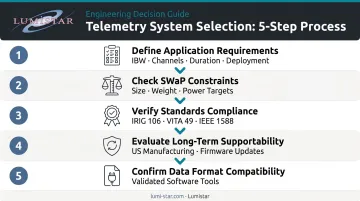
5. Confirm data format compatibility: Verify that your recorder's output files are natively readable by the analysis and archiving tools already in your workflow — without requiring intermediate conversion steps. Ask vendors specifically which software packages have been validated against their output, not just which formats are nominally supported.
Frequently Asked Questions
What is the difference between wideband and narrowband RF signal recording?
Wideband recording captures all spectral content within a broad instantaneous bandwidth simultaneously — nothing within the capture window is missed. Narrowband recording focuses on specific sub-bands. Channelized systems bridge both approaches: they acquire the full wideband signal, then extract narrowband segments digitally via DDC, preserving high fidelity on the signals that matter while reducing storage demands.
What sample rate is needed for wideband RF signal recording?
The Nyquist criterion requires a sample rate at least twice the highest frequency component of interest. In practice, the more binding constraint is sustained write speed to storage: the system must continuously move data from ADC to disk at full rate without dropping samples. Requirements range widely — from tens of MS/s for narrow telemetry bands to multi-GSPS for GHz-class radar and EW capture.
What is IRIG 106 and why does it matter for RF signal recording?
IRIG 106 is the Inter-Range Instrumentation Group standard maintained by the Range Commanders Council Telemetry Group; Chapter 10 (IRIG 106-23) defines the Digital Recording Standard and Chapter 11 defines the Recorder Data Packet Format Standard. Compliance is required for recorder interoperability at US federal test ranges and is a baseline expectation for aeronautical flight test programs.
How much storage capacity is required for wideband RF recording?
Storage scales directly with sample rate, bit depth, channel count, and recording duration. A single 16-bit channel at 1 GS/s generates 2 GB/s; complex I/Q doubles that to 4 GB/s. One hour of recording at that rate requires roughly 14 TB. Bandwidth selection, DDC-based data reduction, and triggered recording are the primary tools for managing this growth.
What role does an FPGA play in a wideband RF recording system?
FPGAs perform real-time digital downconversion, decimation, filtering, and optionally custom signal processing directly on the digitized samples before they reach storage. This reduces output data rates (hardware decimation typically ranges from 4x to 128x) and enables near-real-time analysis without requiring separate post-processing compute resources.
Can wideband RF recorders be used in mobile or airborne deployments?
Yes, and SWaP becomes the dominant design driver in those environments. Lumistar offers ruggedized recorders across three form factors — rack-mount (LS-29-R2, 2U/~11 kg), portable lunchbox (LS-28-DRSM-P1, ~6.8 kg, IP-67 rated), and modular under 1 kg (LS-28-DRSM) — covering antenna pedestal, vehicle, and airborne installations.